Starbucks Bailout Needed

November 11, 2008

After experiencing a 97% decline in profit and an 8% drop in same store sales, Starbucks should also get in line for a federal bailout.  The collapse of Starbucks would pose a “systemic” risk to the economy.  Caffeine-deprived workers would fuel a spiraling decline in productivity.  Withdrawal headaches would spark fights in the streets, family disintegration, and general grumpiness.

And let’s not forget the baristas who risk losing their jobs.  Remember that Seattle was built by baristas who passed the tradition from father to son.  Do we want to turn Seattle into another Flint, Michigan?  Besides, how can we retrain them for other work that would still permit their goatees, piercings, and tattoos?


Republicans to Receive Congressional Bailout

November 10, 2008

(Guest Post by Matthew Ladner)

Good stuff


Just the People You Want Managing Schools

November 6, 2008

Five school districts in Wisconsin have sued their investment advisors after losing $1.5 million on a $2 million investment in collateralized debt obligations.  That’s a 75% loss.  According to the lawsuit, the investment was “complex, convoluted, and opaque, and as Stifel and RBC then well knew, beyond the investment knowledge or experience of the School Districts . . . , their school board members, and their administrators.” 

Complex?  Convoluted?  Opaque? That sounds like just the thing that school officials should put the public’s money in.

But don’t worry.  It’s not their fault that they did something foolish.  It was the fault of the people who sold it to them and they are asking the courts to return the money.  And if that doesn’t work, they’ll just take it from you in future taxes.

I wonder if school officials can do the same if they select foolish educational policies.  If that faddish whole language reading curriculum didn’t work can they sue the people who sold it to them to get their money back?

This all reminds me of a great Shel Silverstein poem:

 Smart

My dad gave me one dollar bill

‘Cause I’m his smartest son,

And I swapped it for two shiny quarters

‘Cause two is more than one!

And then I took the quarters

And traded them to Lou

For three dimes—I guess he don’t know

That three is more than two!

Just then, along came old blind Bates

And just ‘cause he can’t see

He gave me four nickels for my three dimes,

And four is more than three!

And I took the nickels to Hiram Coombs

Down at the seed-feed store,

And the fool gave me five pennies for them,

And five is more than four!

And then I went and showed my dad,

And he got red in the cheeks

And closed his eyes and shook his head—

Too proud of me to speak!


New Evidence Against the Bailout

October 22, 2008

(Guest post by Greg Forster)

As the evidence piles up, I’m moving closer to abandoning my studied neutrality on the bailout and joining Jay and Matt in opposing it. I still lack the expertise to evaluate the claims that there’s a credit panic, that markets behave irrationally during a panic, that panics turn into crashes, and that it is possible for government to prevent the crash by acting as a sort of substitute rational investor during a panic. But whether or not government intervention can counteract a panic, it’s looking more and more like that isn’t what’s happening.

Today’s datum? GM is buying Chrysler partly so that it will be considered “too big to fail.” (HT Jonah Goldberg)

Since I first saw this in The Corner, I’ve been meaning to post it, but haven’t gotten around to it. Glad I waited – now I can also direct you to America’s MVC (most valuable columnist), Holman Jenkins, whose Wall Street Journal column this morning discusses the case.


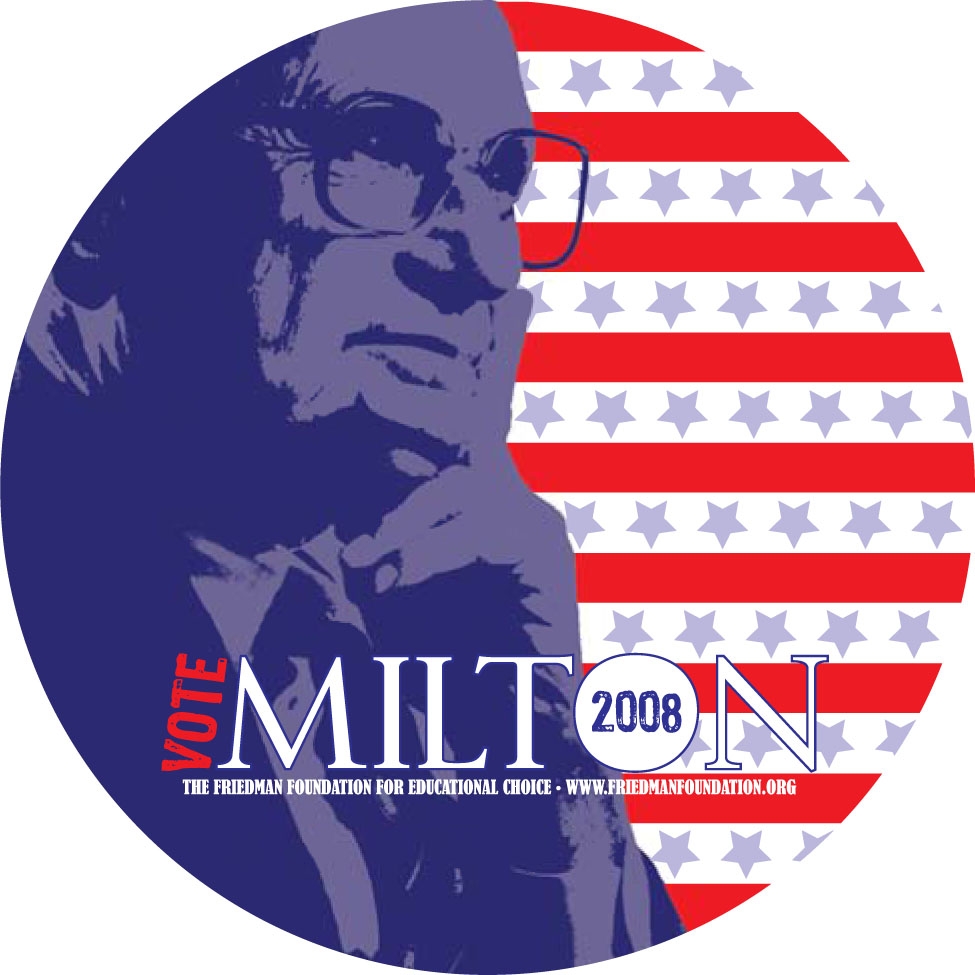
Vote Milton in 2008

October 14, 2008

(Guest post by Greg Forster)

In a recent issue, the Weekly Standard‘s Matthew Continetti vents his anger at the House Republicans who killed the first bailout bill. I was about to quit reading after the first paragraph or so – because, really, why bother? – when this line struck me: “It was the day when Lou Dobbs replaced Milton Friedman as the face of economic conservatism.”

Excuse me? Milton Friedman didn’t even approve of the existence of the Fed. Does Continetti think he would approve of having the government buy $700 billion in financial assets? Would Milton Friedman also support having government buy up people’s mortgages and “renegotiate” the terms, or any other gimmick the GOP happens to dream up in its quest for votes?

It is just barely possible that what Continetti meant, but failed to actually say, was that Friedman would have opposed the bailout in a responsible, intellectually defensible manner, while the House Republicans didn’t. But the whole tone and tenor of Continetti’s article suggest otherwise. I’m afraid it looks a lot like Continetti simply identifies respectable and responsible economic conservatism with support for the bailout, and of course Milton Friedman is the respectable and responsible economic conservative par excellence, and Continetti failed to think through the implications. I wish he were the only bailout defender who took this attitude.

The whole thing reminded me of a classic William F. Buckley column entitled “Quick! Get Milton Friedman on the Line!” and published on Oct. 22, 1987, right after the Black Monday market crash. The entire column consists of a transcript of Buckley’s phone call to Friedman after the crash. I’ve emphasized a few lines that might be of heightened interest in light of current events:

How are you, Milton?

We’re fine, how are you?

I was wondering whether you could do me a favor. I would like nine hundred words for National Review on the market breakdown. We would need it by Thursday, noon.

Nope.

Why not?

I have never written an economic analysis tailored to the market, and I’m not going to start doing that now.

Why?

Because the behavior of the market doesn’t correlate in any significant way with the behavior of the economy. It’s a mistake to imply that it does, and that would be inferred if I wrote about it.

Well, why don’t you write precisely on that theme? And it wouldn’t be cheating, would it, if you were to suggest what the investor might expect from the market, given the condition of the economy?

Yes, it would – I would be in the business of vetting the market, and I just told you, I’m not going to do that. I make my own decisions about the market, but not for public instruction. I sold all my stocks during the summer.

You did!

I did. And I’m going back into the market tomorrow.

Later, Buckley remarks that “the talk is of another 1929 depression,” to which Milton replies, “nonsense.”

Well, do you subscribe to the proposition that there are safeguards built into the system that would prevent a depression on a 1929 scale?

In 1954, I delivered a lecture in Sweden under the title, “Why the American Economy is Depression-Proof.” I have seen no reason since then, and see none now, to change that conclusion.

But your position all along has been that even the Great Depression was avoidable, correct? Even without the Federal Deposit Insurance Corp., and the SEC, and Social Security, et cetera?

Yes. The economic downturn from August 1929 to the end of 1930 was more severe than during the first year of most recessions, but if an upturn had come shortly after, the episode would have been classified as a garden-variety recession. It was converted into the Great Depression by the collapse of the financial system in successive waves. In 1931, 1932 and 1933. The stock market played no significant role in this collapse. The argument that the 1929 market crash produced the 1931 to 1933 economic contraction is a prime example of post hoc, ergo procter hoc.

You’re saying that it could all have been avoided?

Yes. The financial collapse of 1931 to 1933 need not have occurred and would have been avoided if the Fed had never been established, or if it had behaved differently. The Fed’s inept performance led to changes in the financial system that make a similar financial collapse highly unlikely.

Well, that’s good news, isn’t it?

Yes, that’s good news.

I still don’t see why you won’t write nine hundred words on just what you’ve said for National Review.

You’ve got nine hundred words in what I’ve just said.

Good point. Thanks a lot, Milton, and good night.

Good night, Bill.

The column appears in Buckley’s Happy Days Were Here Again.

As the election approaches, the Friedman Foundation’s choice of “Vote Milton in 2008” as the theme for this year’s Friedman Day feels more and more appropriate.

Coming Tomorrow: Did Milton Friedman oppose financing school choice through tax credits? Archeologists have uncovered startling new evidence! Tune in for the text of a newly discovered letter in which Milton lays out his position.


David Warren Bails Out on the Bailout

October 13, 2008

(Guest post by Greg Forster)

On this page I’ve cited comments by Canadian columnist David Warren as providing potential support for backers of the bailout. I don’t think, however, Warren had explicitly taken a position. Well, now he has, and it turns out he’s against. I figured out of fairness I should take note of it. I think Jay will particularly like the way he puts this:

Were it not for the panic, very little would be lost. The things that we produce by our labour we may continue to produce, so far as they are needed; and the things we need may continue to be produced, in exchange. Money itself, so long as it is taken at face value, may continue to be the convenient mode of exchange. Neither now, nor in 1929, nor in any of the other times of stock plunge and bank failure, has anything much been lost, until, to use Franklin Delano Roosevelt’s phrase, “fear itself” became the enemy of the people.

For in practical terms, the stocks on Wall Street are not worth nothing. Formidable agencies of production lie behind each of them. When their heads have cooled, investors may sort out which are over-valued, which under-valued by comparison, and what needs writing off. The more I try to think it through, the clearer it seems to me that every “rescue plan” is counter-productive. The sorting-out process is seriously confused when the government blunders in.

Indeed, the consensus of the economists I have read is that the Great Depression was largely an artifact of government intervention, reacting to a meltdown by freezing it into place. For politicians and bureaucracies characteristically mistake money for goods, words for things, pictures for reality.

Warren has actually been on fire for the past couple weeks; Mark Steyn has recirculated this thoughtful column on the “two solitudes” in U.S. politics, and with Canada having its own election underway, Warren’s relentless attacks on Conservative PM Stephen Harper (“Twice I have tried to unload the contents of a column over the head of Stephen Harper, whose betrayal of conservative causes I have been inclined to take personally. The other candidates do not annoy me nearly as much, since I have never been tempted to like, admire, or support any one of them.”) culminated in this paean to the (now apparently defunct) “returned ballot” rule, which once allowed a Canadian to show up at the polling place and formally register that there was no candidate for whom he would care to vote.


Song for Today

October 10, 2008

(Guest Post by Matthew Ladner)

Stock portfolio taken a dive? Cheer up…you could be running a gin-joint in a third world country controlled by the Nazis and run into your long lost love, only to find that she is married to the leader of the resistance.


Feeling Stabilized Yet?

October 10, 2008

Congress passed the Emergency Economic Stabilization Act (EESA), but the markets have hardly stabilized.  Don’t the markets know that it is against the law for things not to be stable now that Congress passed a stabilization act?

I think recent events demonstrate that the EESA was completely unhelpful if not counter-productive.  But others interpret events as showing that the EESA didn’t go far enough.  I’m sure that there are also Marxist academics out there still arguing that full communism has never really been tried because the Soviets didn’t go far enough.  And there are education interest groups saying that the doubling in real per pupil spending hasn’t yielded academic improvement because we haven’t spent enough yet.  Something didn’t work?  Just try more of it!

Well, I came across a very sensible op-ed in the WSJ yesterday that offers an explanation for why the crisis continues and what might be done to really bring about stability.  Manuel Hinds suggests that the problem at this point is that financial institutions are refusing to lend to each other.  The problem is that some of those institutions won’t repay money that is lent to them because they are truly insolvent, but no one knows for sure who those institutions are.  So the safe thing to do is not to lend to any other banks.  But this lack of inter-bank lending is having a negative spiral effect.  Hinds likens the problem to playing poker with ten people knowing that a few aren’t good for their chips.  No one will play until you figure out who can settle at the end of the game. 

The solution is to improve transparency so that we all more clearly know who is and who isn’t able to repay money that is lent to them.  One of the best ways to gain that transparency is to allow insolvent institutions to go bankrupt so that we know the ones still standing are healthy.  Efforts to prop up insolvent institutions just prolong the crisis by disguising who really can repay and who can’t.  It would also be essential for transparency to continue mark-to-market accounting, despite calls to do away with it.  Without mark-to-market we would have much less information about the value of securities held by financial institutions.  More information is the solution and ending mark-to-market subtracts information.  There may also be reasonable regulations that would improve the quality of information about financial institutions.

There are real problems in financial institutions but masking them just makes the problem worse.

(edited for typos)


Talking ‘Bout a Revolution?

October 8, 2008

(Guest Post by Matthew Ladner)

I have an admittedly odd appreciation for left-wing protest songs. For my money (sorry baby-boomers) there is none finer than Tracy Chapman’s Talkin’ Bout a Revolution. Released in 1990, Chapman’s spare and urgent song delivers an ominous warning:


Don’t you know they’re talking about a revolution?

It sounds like a whisper


While they’re standing in the welfare lines

Crying at the doorsteps of those armies of salvation

Wasting time in unemployment lines

Sitting around waiting for a promotion


Don’t you know they’re talking about a revolution?

It sounds like a whisper


Poor people are gonna rise up

And get their share

Poor people are gonna rise up

And take what’s theirs


Although stirring, the underlying assumptions of this song are dead wrong. Income redistributing revolutions obviously have a romantic appeal to some, but rather sordid history in practice. Ask the Russians.


Anti-poverty strategies fall into two broad categories: redistribution plans and growth oriented plans. One can either try to take wealth from one group and give it to another, or else focus on creating more wealth for everyone.


Today, the growth strategy stands triumphant.


A recent World Bank report, for example, finds that we are living in a golden age of global poverty reduction. The World Bank notes that economic growth is producing a “spectacular” decline in Asian poverty. In 1990, there were over 470 million people in the East Asia and Pacific region surviving on less than $1 a day. By 2001, there were 271 million living in extreme poverty- a 42.5% decline.


The World Bank projects that by 2015 there only 19 million people will be living under such squalid conditions- a 96% decline in twenty-five years. A complete elimination of extreme poverty in this region seems entirely possible well within our lifetimes, thanks to high rates of economic growth and job creation. Free market policies are lifting millions out of poverty, in stark contrast to the catastrophic consequences of income redistribution policies of socialist and communist regimes.


Other parts of the world, notably Africa, have not been doing nearly as well. A broad consensus now exists in explaining the reason. The work of Hernando de Soto on development economics, for instance, has convinced observers from Bill Clinton and Kofi Annan on the left to Ronald Reagan and George W. Bush on the right that a system of property rights is absolutely critical to allowing economic growth and thus eliminating poverty.  Why do some countries remain mired in poverty? People cannot own property such as land, they cannot reliably contract with each other. Rotating cliques of kleptocrats often take turns using government as an instrument of theft, corruption, and oppression. Poverty will not decline without addressing these fundamental flaws, regardless western aid.


One does not need to look abroad for examples of growth reducing poverty. In 2006, the Goldwater Institute released a study comparing the relative success of states in reducing poverty during the 1990s. The study found that during the 1990s, on average high tax states had increases in poverty rates during the booming economy of the 1990s, while low tax states on average saw larger than average declines.


Economic growth (or lack thereof) can quickly make a big difference in poverty statistics. Mississippi began with the highest poverty rate in the country in 1990, twice as high as California’s poverty rate (25% compared to 12.5%). Enjoying the benefits of economic growth, Mississippi’s poverty rate dropped by 20% in the 1990s, while poverty increased by 13.6% in California. If such rates were to be sustained (by no means a given) then California would overtake Mississippi in poverty rates by 2010.


As we struggle through the current financial crisis, we must take care to remember the radical success of free trade and free market polices have produced in reducing poverty. Those who promoted free trade, property rates and lower taxes weren’t just talking about a revolution: they delivered one.


Small Children Suffer So Billionaire Lawyers Can Profit

October 8, 2008

(Guest post by Greg Forster)

I am an angry man this morning.

My daughter, who just turned three, can’t talk much yet. (For the record, that’s not her picture at the top of the post.) Of all the difficulties she goes through because of her very limited ability to speak, one of the worst is that when she’s scared or in pain, she can’t tell us what’s wrong. She’s accustomed to communicating with us (through sign language, by pointing, by pulling us over to something, and through the limited set of words she can use), so when she desperately needs to communicate that her throat hurts or her head hurts and she doesn’t know how, she panics. Ordinary illnesses are terrifying to her. And of course that makes them doubly painful for us.

We thank God for the medicine companies that have produced the pain relievers and other medicines that get our daughter, and us, through these ordeals. I can only imagine what my daughter’s life would be like if she couldn’t take medicine to relieve her pain, and her terror.

On page B8 of your Wall Street Journal this morning, you will find a story about how the medicine companies that make children’s cold and cough remedies are “voluntarily” relabeling their products at the “request” of the FDA. These medicines will now be (mis)labeled with the warning that they shouldn’t be given to children under four.

These medicines are known to be safe for small children when used as directed. The FDA doesn’t dispute this. If the FDA had a legitimate reason to act, it wouldn’t make a request, it would make a rule, and enforce it.

These medicines were even marketed for children under age two until last October, and that change was also made “voluntarily” at the “request” of the FDA.

When the FDA requests that medicine companies voluntarily do something, it’s like when Vito Corleone summons the undertaker to the morgue and asks if he’s prepared to do him a favor.

So what justification was given for this request? Well, it seems that two-thirds of ER visits associated with these medicines come from children under four accidentally ingesting them. Different sources are saying either 6,000 or 7,000 ER visits are associated with these medicines, meaning that we’re talking about roughly 4,000 visits. [UPDATE: It appears to be 6,000 visits by children under 6, 7,000 visits total. It’s not surprising that most of the visits are by children under 6 given that these are medicines specifically marketed to young children. But that only makes it worse. The FDA is alarmed because, out of all ER visits by children under 6, two-thirds are by children under 4. Think about that. It’s like the old Dilbert cartoon where the boss is enraged that 40% of all sick days are taken on Monday or Friday.]

Most of the ER visits presumably don’t result in death or even long-term health impacts. If these medicines killed 4,000 children a year, the FDA would have acted against them openly rather than by subterfuge, and it would have done so a long time ago.

Who gets to speak for the millions of children who will suffer, over and over again, suffer every moment of pain that an untreated illness causes, because a relatively tiny number of parents can’t be bothered to store their medicines properly and as a result they have to endure one lousy ER visit? No one.

I am an angry man this morning.

Why would the FDA do such a moronic thing? We all know the answer. I don’t even have to say it. (Check the title of the post if you’ve forgotten it.)

Now, I know that in reality, many parents will keep on using these medicines. But some won’t. Lots of parents trust the FDA, more fool they. And what about future parents, who aren’t paying attention to what the FDA does today because they’re not parents yet? No dobut some will hear the truth, but others won’t. And what if the drug companies decide that now that these medicines are labeled for kids over four only, they can up the dose? We can watch for that, of course, but it’s one more obstacle between children and pain relief.

By tomorrow I will have resigned myself to this latest injustice. By now I ought to know better than to get this mad. I’ve spent my career fighting a government school monopoly that systematically destroys children’s lives so that the unions can make the gravy trains run on time. I can write about that without getting mad; if I got mad every time I contemplated the injustice of the system, I couldn’t do what I do. Why am I mad when it’s my daughter and not somebody else’s?

Because I’m human, I guess.