Pass the Popcorn: We Were Voyagers!

December 1, 2016

exploring

(Guest post by Greg Forster)

I am a girl who loves my island; I am the girl who loves the sea

It calls me!

I am the daughter of the village chief; we are descended from voyagers who found their way across the world

They call me!

I have delivered us to where we are; I have journeyed farther; I am everything I’ve learned and more

Still it calls me!

This delightful movie speaks, not always clearly but always movingly, to some of the central tensions of advanced modern life. We need both tradition and discovery; we need both inner-looking integrity and outward-looking responsibility. Ultimately, we need God, who alone can transcend and reconcile these contradictory needs, sweeping aside the artifical barriers we create to divide them for our own purposes.

I’m not sure what’s more amazing, that a movie this good has four directors, or that two of them are the directors of The Little Mermaid – the high water mark of the Bad Old Disney – yet the occasional intrusions of Bad Old Disney thinking are actually swept up and incorporated (probably against rather than according to the directors’ purposes) into a whole that is very much of the New Disney, the Disney that cares about the transcendent.

Only very general spoilers follow, nothing highly specific. But if you intend to see the movie, better to set this aside and come back when you’ve seen it.
voyagers

“When It’s Time to Find Home, We Know the Way”: Tradition and Discovery

Moana is raised in a closed, tradition-bound society but longs to explore and discover, which she can only do by leaving her island behind. We, living in an open, scientific society, long for stable sources of identity, meaning and purpose, which is why we like to watch movies that take place in ancient times and places, when people knew who they were.

If this had been a Bad, Old Disney movie, the lesson would have been that “tradition” is either a bad thing or, at best, something that must bow the knee to the Brave New World and the quest for knowledge and discovery that will inevitably marginalize tradition. (Remember the great modernist quip in Sleeping Beauty: “After all, this is the fourteenth century!”)

Not here. Moana discovers that her traditionalist father has withheld from her the elements of the tradition that favor exploration and discovery – he has suppressed the part of the tradition that is anti-traditionalist. She discovers that her ancestors were voyagers who explored the world and colonized the empty islands as they found them.

“We are explorers reading every sign,” sing her ancestors, but also: “We tell the stories of our elders in a neverending chain!”

“We set a course to find a brand new island everywhere we roam” but “when it’s time to find home, we know the way!”

“We know where we are, we know who we are!”

Traditions embody commitments that are not themselves traditional, or at least not tradition-bound. The village didn’t just sprout up on the island; the villagers came from somewhere.

In the Bad, Old Disney, tradition was simply a relic to be surpassed by the great voyage of discovery. Here, the voyagers have a tradition – voyaging is the tradition – and it tells them who and where they are.

Her father has suppressed all this because a new danger appeared on the ocean; like all traditionalists, he thinks safety is to be found by retreat into a closed system of tradition. But traditions themselves speak against this; they point outside themselves to the higher things that traditions exist to serve.

Traditionalists always want to burn the boats. But it was our ancestors who made them.

mom

“I Am Moana”: Identity and Purpose

We need tradition because we need identity (“we know who we are”). We need discovery because we need purpose, a calling to which we aspire (“it calls me”). But it’s hard to hold on to both.

Identity requires an inward movement toward integrity, in the literal sense of that term – we need wholeness, a fitting together of all our pieces into a sum greater than the parts.

Purpose requires an outward movement toward responsibility – we need to be called out of ourselves, to serve something higher than ourselves.

Identity without purpose is narcissistic. Purpose without identity destroys our humanity.

The moment of greatest crisis, which I will not reveal, comes when Moana can no longer attach the person she is to the calling for which she has been chosen. The crisis is resolved when an outward calling brings her to an inward realization of their connectedness.

As I’ve said, there’s some intrusion of the Bad, Old Disney in Moana. It comes in the form of “look inside yourself,” “follow your heart,” “be who you are on the inside,” etc.

But here, that language – which remains dangerous – is used in the service of higher things. “Look inside yourself” is playing with fire, but as Moana shows, it is (to borrow a fine phrase from Allan Bloom) fire with which we must play if we are to transcend it.

Family is part of the answer. This is one of those rare (but less rare than they used to be) Disney movies with an intact family at the center. And it is noteworthy that her father, her mother and her grandmother are all necessary to Moana’s story. Without any one of them, the story either wouldn’t happen or wouldn’t happen the way it should.

In the family, both identity and purpose are provided for. Your family loves you and wants you to be a person with wholeness, but also calls you out of yourself to the service of others – at first, the others within your family, but ultimately the community at large.

The unconditional love of the family is essential. One of the lessons of the movie is that efforts to earn love and acceptance are futile; the love and acceptance thus “earned” are not authentic love and acceptance.

However, the family is not enough. A greater love is required.

Moana’s grandmother passes on to her the suppressed part of the tradition, and clarifies for her the calling for which she was chosen, because and only because a higher power to which the grandmother is devoted has provided for her to do so.

scared

“The Ocean Doesn’t Help You”: The Mystery of Divine Calling

Darkness is rising and monsters have appeared because we sought to steal from the gods the power of creation itself.

To redeem the world, the ocean has chosen Moana for a high and dangerous quest. If anyone else attempts to stop her, the ocean intervenes to keep a path to her quest open for her.

Moana herself, however, the one who has been chosen for the calling, can refuse the calling if she chooses.

At first there’s no question what she will choose, because the outward calling that comes to her from the ocean connects so clearly to the inward calling she senses inside herself, that she understands to be the true center of her identity.

But then comes suffering and failure. And the ocean doesn’t help. If the ocean wants these things done, why doesn’t it help?

“The ocean doesn’t help you” says the unwise man, “you help yourself.”

That turns out to be empty. When the unwise man gets wiser, he says of his efforts to help himself: “It was never enough.”

It never is. But the ocean still doesn’t help.

At first, the divine call resolves our tensions – by its transcendent authority it supercedes and breaks down our artificial divisions between tradition and discovery, between identity and purpose. It demands both; because, and only because, it demands both with an authority higher than both, it gets both.

But then the ocean doesn’t help.

At the end of all things, Moana is left floating alone on a raft at night, in the middle of nowhere, unable to find the path to her quest.

She has been chosen for the calling, but she can refuse the calling if she chooses.

She faces the same question she thought she had left behind her: “Moana, do you know who you are?”

The divine call, coming to her from outside, has not resolved that question. She must resolve it inwardly. She must – dare I say it – look inside herself.

Not for narcissistic self-expression but to discover who it is that the ocean is really calling.

And what she discovers leads to a surprising redemption.


The Next Accountability: Choice, Polity and a New Definition of Reform

November 30, 2016

Little-sprouts_-Grow-bean-sprouts-in-your-back-garden

(Guest post by Greg Forster)

Today EdChoice has released the final installment of my series on The Next Accountability. A while back Matt said he was curious how I would “land the plane” after the lofty heights to which the early installments soared – canvassing big questions about the meaning of life and the future of democratic pluralism.

Well, here’s how I land it: The next accountability should be grounded in:

  • Empowering parents through school choice and local information systems
  • Devolving polity so principals and local districts govern schools close to communities
  • Reforming our movement’s principles to describe education the right way

The last one will probably be the hardest for the movement to grasp but may be the most important in the end:

Markets and competition as drivers of efficiency and performance are important. But they do not provide the moral norms and narratives needed to inform the next accountability. The best case for universal school choice does not center on them. These should be secondary, not primary themes.

We should develop ways of articulating these principles as the basis of the next accountability:

  • The purpose of education is to help children develop the knowledge, skills and virtues they need to live a good life—achieving and appreciating the true, good and beautiful—and to live as good citizens of a community where we disagree about what is good.
  • To cultivate these, we need teachers who are wise professionals (possessing the qualities they seek to instill, and guided by an independent professional ethic) and schools that are free communities (where shared purpose, not the arbitrary dictates of distant authorities, shape a shared life).
  • Teachers and schools can educate the individual student for free pursuit of the good life as he or she sees it, and also for good citizenship and respect for others’ rights in a diverse community, because of what we share in common as human beings and as fellow Americans.
  • Teachers and schools should be held accountable to do this by parents and local communities—the more local the better—because they are in the closest moral and social connection to schools, and can therefore hold them accountable in ways that support their social fabric rather than disrupting it.

Of course, this series is only a down payment on what needs to be a long-term change in the way we think and speak about accountability. But I had a huge amount of fun writing it and I’m convinced that something like this direction is the only real hope for educational accountability after the coming collapse of technocracy.

As always, I’d love to hear your responses. Thanks for reading!


School Choice’s Time for Choosing

November 24, 2016

img_1358

“This is wheeeeeeere the party ends…”

(Guest post by Greg Forster)

The most realistic thing about fairy tales is this: You don’t realize you’re making a titanic moral choice that will determine whether you triumph or die until the moment after you have made the choice.

Betsy DeVos will likely make a very good education secretary if 1) she can prevent her department from sabotaging her and 2) she focuses on choice and puts Common Core and all associated initiatives to rest. #2 is highly likely given what was said during the campaign. #1 is always something of a crapshoot. Being a conservative cabinet secretary is an inherently dangerous undertaking.

But I’m less interested in her choices and more interested in the choices of the school choice movement.

Trump will be president. All of us who work on policy issues have to live in a world where Trump is president. It’s not necessarily a good idea for every decent person to shun him; that means government will be run by scoundrels like Trump.

Every movement needs its Vaclav Klauses as well as its Vaclav Havels – people who are willing to hold their noses and work for a corrupt regime. You simply can’t get anything done otherwise, because there are no non-corrupt regimes.

Milton went to Chile and advised Pinochet. When challenged, he said: “I gave him good advice.”

But if they forget to hold their noses, if they think the regime is good, the movement dies. And they will forget if no one plays Vaclav Havel and goes to jail for telling the truth about the regime.

My biggest fear is that the school choice issue will become tied to Trump. It can never be said too many times: Donald Trump is a notorious racist who discriminates against blacks in his businesses, said a judge of Mexican ancestry couldn’t judge him impartially, constantly flirted with the alt-right, and refused, three times, to repuidate the KKK when first asked to do so. (Just in case this is unclear, the KKK is a criminal organization that murders people and exists to make war on the US government in the name of white nationalism. If Trump wants to learn more about it, he can ask his attorney general, who had a Klan leader executed.)

We in the school choice movement have spent a generation building bridges between the conservatives and libertarians traditionally associated with the issue and progressives and ethnic minority communities. We can’t afford to throw all that away.

But in the last few years the Common Core disaster has polarized the education reform movement. CC progressives (not identical with choice-friendly progressives, although there’s overlap) have declared war on conservatives, denouncing us as racist for the crime of not being progressives.

So far that hasn’t had much effect on the choice wing of the movement’s relationships with minority communities. But we choice people increasingly feel outcast, despised, wronged by those whom we had regarded as friends and allies, but who turned on us the moment they found it expedient to do so.

The temptation will be to say “F all these progressives who stabbed us in the back for Common Core, and who now tell us we’re racist solely because we’re not left-wing extremists. Let’s go all in with someone who won’t tell us we’re evil for being conservative.”

And of course that will be the death of us. Because then we really will have turned a blind eye to racism.

We should keep the focus where it belongs: on the states. If we’re offered a big federal push to impose choice on the states, we should say “thanks, but no thanks.” On the merits, yes, and for other reasons, too.

As someone once said on this issue, you can’t shake the devil’s hand and say you’re only kidding.

We can work with Trump (on, for example, choice in DC and other federal jurisdictions) the same way we might work with any bad person who holds office. But with the demonization of conservatives in the movement and the big opportunities for choice that Trump will soon likely be offering us, the temptation will be to forget what we spent the last generation saying: That school choice will die if it doesn’t build a trans-partisan, trans-ethnic coalition.


Understanding Bigotry

November 23, 2016

american-river-ganges-sept-1871

(Guest post by Greg Forster)

I am deeply impressed by, but feel the need to add something to, Neal’s very gutsy column on trying to understand what appears to be bigotry.

Neal is right that what appears to be merely bigotry is often at least mixed with other, less objectionable concerns; and sometimes what appears to be bigotry may not be bigotry at all. As Neal points out, American Protestant responses to Roman Catholic immigration were at least partly colored by the knowledge that Catholic/Protestant differences had led to extended warfare in Europe, and usually the only viable path to peace had been to separate the two populations.

I would apply this in our own day by saying that populations that appear bigoted are often just low-information voters who have tuned out the dinosaur media completely (and with very good reason!) and thus have never been told that Donald Trump is a notorious racist who discriminates against blacks in his businesses, said a judge of Mexican ancestry couldn’t judge him impartially, constantly flirted with the alt-right, and refused, three times, to repuidate the KKK when first asked to do so. They simply don’t know these things because the news sources they trust (Fox, Rush) have decided not to tell them.

In light of this, I think the following also needs to be said:

  1. The more aggressive we are in repudiating real bigotry, the more credibility we will have to discuss what may or may not be real bigotry. If more conservative and GOP leaders had done the right thing during the election and repudiated Trump as beyond the pale and unsupportable regardless of all other factors because of his shameless racism, it might be possible now to get a hearing for the case that many or even most low-information Trump voters don’t know he’s racist. I’m not optimistic about that now. It may be true – I think it probably is true – but no one will buy it.
  2. There is a heavy reckoning awaiting the conservative and GOP leaders who chose to turn a blind eye to what Trump really is, and the right-wing news sources that chose not to tell their audiences.
  3. In an email, Neal says “a lot of Americans used to fear my religion.” What does he mean, “used to”?

The Next Accountability – Individuals and Communities

November 17, 2016

Little-sprouts_-Grow-bean-sprouts-in-your-back-garden

(Guest post by Greg Forster)

EdChoice has published Part 4 of my series on The Next Accountability, in which I argue that an understanding of human nature and the American experiment in freedom and diversity is needed to ground a new approach to education in a pluralistic society:

The whole beauty and glory of America is that it seeks to respect differences and protect people’s freedoms and rights without giving up this shared life. Any idiot could have created a plan for a pluralistic society in which people with different views were kept in separate cultural compartments that didn’t share a common civic identity, marketplace and justice system. In fact, such systems are not uncommon in global history. What took a world-historical level of genius (and audacity!) was to construct a social order in which diverse people would share all these things, while remaining diverse.

To create new accountability systems, we must figure out how schools fit into this tapestry of pluralistic community. Schools are educating students who come from this unique social environment, and who will, upon graduation, go out into it to live the lives schools are preparing them for.

At a time when our choice seems to be globalist technocracy or tribalistic nationalism, a recovery of this vision is more needed than ever.


Reforming School Governance

November 15, 2016

img_1349

(Guest post by Greg Forster)

OCPA’s Perspective carries my article on school governance reform:

Governance reform means changing the system’s internal decision-making and authority structures. Parental choices and academic standards enforced by tests are both ways of placing external pressure on the system to perform. We can also do a lot of good by changing the shape of the system’s own workings. School board elections, building-level autonomy, principal training, transparency measures, and breaking up our bloated school district system are all places where there’s a lot of potential improvement.

As always your comments are welcome!


Win-Win Update at Perspective

November 1, 2016

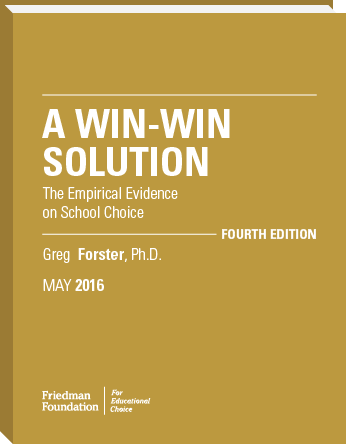
2016-5-Win-Win-Solution

(Guest post by Greg Forster)

OCPA’s Perspective carries my article on the research showing school choice improves academic outcomes at public schools – including an update since the publication of my latest Win-Win report, with a new study from Fordham finding Ohio’s voucher program improves reading and math scores in affected public schools:

This study improves on the two previous studies of the Ohio program (one of which I conducted), both of which also found it improved public schools. Figlio and Karbownik had access to individual student data, rather than having to use aggregate school-level scores, which is more accurate. They also use a “regression discontinuity” method, comparing schools that landed just barely above and just barely below the threshold for voucher eligibility. This is a better apples-to-apples comparison of schools.

But why be surprised? These days even NEPC and Christopher Lubienski have finally admited that school choice improves outcomes, although only participant outcomes. Lubienski mysteriously refused to look at my report’s review of effects on public schools, fiscal effects, segregation effects and civic effects. I can’t imagine why!

The win-win solution continues to rack up wins. Stay tuned.


For the Al: Master Sergeant Roddie Edmonds

October 25, 2016

showimage

(Guest post by (((Greg Forster))))

“They cannot all be Jews!”

The Battle of the Bulge, one of the largest battles in the largest war in world history, produced thousands of prisoners. Among the prisoners in the Stalag IXA camp were about one thousand men of the U.S. 422nd Infantry Regiment, who found themselves under the command of Master Sergeant Roddie Edmonds – a non-com, but still the regiment’s most senior surviving member.

Last year, his son, Rev. Chris Edmonds, had his first full opportunity to share his father’s story with the world – by dumb luck, just a month too late for his father to participate in last year’s Al Copeland Humanitarian of the Year Award process.

But The Al has a long memory, and it will take more than a little time to make it forget Master Sergeant Roddie Edmonds.

By standing German policy, Jewish POWs were to be separated from the rest of the POW population. By this time, the largest of the death camps in the western theater were no longer in business, so most of these POWs were taken away to slave labor camps where they were, with less efficiency but no less contempt for their humanity, worked to death.

Speaking in English, the German camp commander – a Major Siegmann – approached the POWs of the 422nd. He ordered that all Jewish men were to fall out and stand in formation in front of the barracks, then went to await them.

Whereupon Master Sergeant Roddie Edmonds ordered every man under his command to fall out and stand in formation in front of the barracks.

“I would estimate that there were more than 1,000 Americans standing in wide formation in front of the barracks with Master Sergeant Roddie Edmonds standing in front, with several senior non-coms beside him, of which I was one,” recalls Lester Tanner, a Jewish member of the regiment.

Siegmann protested: “They cannot all be Jews!”

Master Sergeant Roddie Edmonds replied: “We are all Jews here.”

Siegmann drew his sidearm and held it to Edmonds’ head.

Edmonds said: “According to the Geneva Convention, we only have to give our name, rank and serial number. If you shoot me, you will have to shoot all of us, and after the war you will be tried for war crimes.”

Siegmann, having been (in the words of the Jerusalem Post) “outfaced by Edmonds,” turned and walked away.

More than 200 of the prisoners were Jewish (all the time, that is, not just when Nazis were asking). Edmonds saved them all from near-certain death.

Chris Edmonds knew his father had spent 100 days in captivity, but had no idea anything like this had happened until he read a newspaper story a couple years ago about Richard Nixon’s post-presidency search for a New York home. The article mentioned Tanner, who sold Nixon his house, and included the story about his father. Chris Edmonds began tracking down Tanner and other corroborating evidence, culminating in Master Sergeant Roddie Edmonds being named “righteous among the nations” by Yad Vashem last December. He is only the fifth American, and the first American serviceman, thus honored.

Just two weeks later, a more contemporary headline showed that the spirit of Roddie Edmonds lives on: “Muslims Protect Christians from Extremists in Kenya Bus Attack.” About a dozen heavily armed Somali terrorists captured a bus in El Wak, Kenya and demanded that the passengers disembark, with all Muslims moving to one side of the bus while Christians moved to the other side. But the Muslim passengers refused to cooperate, preventing a massacre. “These Muslims sent a very important message of the unity of purpose, that we are all Kenyans and that we are not separated by religion,” said Interior Minister Joseph Nkaissery. “Everybody can profess their own religion, but we are still one country and one people.”

Tanner recalls of Edmonds: “He did not throw his rank around. You knew he knew his stuff and he got across to you without being arrogant or inconsiderate. I admired him for his command.”

Now, so do we all.


The Next Accountability – Failure of Technocracy

September 28, 2016

Little-sprouts_-Grow-bean-sprouts-in-your-back-garden

(Guest post by Greg Forster)

EdChoice just posted Part 3 of my series on The Next Accountability. Having discussed what we want from education and how schools best deliver it, I now turn to why technocratic accountability systems get in the way – and, by their nature, always must:

The logic of technocracy is simple: Let’s forget about the things that we strongly disagree about, and focus on the things that everyone ought to be able to reach agreement about pretty easily. As a result, technocracy effectively narrows down the agenda for the head to reading and math scores, keeps the agenda for the hands hopelessly vague (“critical thinking”) and keeps silent about the heart. What makes this so tempting is the illusion that we can avoid uncomfortable, potentially divisive questions about what is good and right…

Whatever its intentions or motives, technocracy in practice imposes a vision of the good for education that includes everything that is widely agreed to be good, and effectively excludes—treats as not essential to good education—everything that is subject to serious disagreement.

I also have a word (as I often do) for my friends in the school choice business:

Technocracy can only be countered by a better, truer and more attractive vision of the human good that education can serve. We are a free and diverse country, a community where neighbors live together while disagreeing about what is good, true and beautiful. But that very truth—that we are a free and diverse country, a community where neighbors live together while disagreeing about what is good, true and beautiful—moves us in deep and powerful ways as we contemplate it. Our shared goal for education can be precisely the cultivation of that kind of free community.

This is why, as I emphasized in the introduction to this series, talking points and canned rhetoric about “markets” and “competition” are woefully inadequate to the needs of the present moment. The claims many of us have made about the benefits of markets are true. But we must ground our case in what it means to be human in what the head, the hands and the heart need from education. We need a humane vision of what education is for that is more attractive than the technocratic vision.

Your thoughts, questions, comments and rotten vegetables are (as always) appreciated!


Parent Power Gives Teachers Freedom to Teach

September 20, 2016

classroom-435227_640

(Guest post by Greg Forster)

OCPA’s latest Perspective carries my article reviewing evidence suggesting that, where parents are in charge of education, teachers are free to teach. The data come from a study of federal teacher surveys that I did with Christian D’Andrea in 2009, but they are of fresh interest in light of the recent crisis over accountability in education reform.

Government power over schooling harms teachers in many ways. It takes away their control over what and how they teach:

On accountability, we found private school teachers were much more likely to say they have a great deal of influence on performance standards for students (40 percent versus 18 percent), curriculum (47 percent versus 22 percent), and discipline policy (25 percent versus 13 percent). They were also more likely to have a great deal of control over selection of textbooks and instructional materials (53 percent versus 32 percent) and content, topics, and skills to be taught (60 percent versus 36 percent).

It also saddles teachers with a legal and regulatory environment that prevents them from keeping order:

Shockingly, we found public school teachers were four times more likely than private school teachers to say student violence was a problem on at least a monthly basis (48 percent versus 12 percent). That means about half of public school teachers are being asked to work in an environment where violence is a regular problem. Nearly one in five public school teachers had been physically threatened by a student, compared to only one in 20 private school teachers (18 percent versus 5 percent). Nearly one in 10 public school teachers had been physically attacked by a student, three times the rate in private schools (9 percent versus 3 percent).

Where student violence is a problem on some days, student disorder is a problem every day. Sure enough, we found public school teachers were much more likely to report that student misbehavior (37 percent versus 21 percent) or tardiness and class cutting (33 percent versus 17 percent) disrupt their classes. One in eight public school teachers reported that physical conflicts among students occurred every day; only one in 50 private school teachers said the same (12 percent versus 2 percent). How are teachers supposed to teach?

The institutional environment is undermined by government control in other ways, too, undercutting teachers’ relationships with peers and school leaders:

Where parents are in charge, the school is free to be itself, and that cultivates a strong spirit. Private school teachers were much more likely to strongly agree that there is a great deal of cooperation between staff members (60 percent versus 41 percent), that their colleagues shared their values and understanding of the core mission of the school (63 percent versus 38 percent), and that their fellow teachers consistently enforced school rules (42 percent versus 29 percent).

These intangible factors affect how schools manage their more material affairs. Private schools almost always have smaller budgets than public schools. Yet somehow private school teachers were more likely to strongly agree they had all the textbooks and supplies they needed (67 percent versus 41 percent). They were also more likely to strongly agree they got all the support they needed to teach special needs students (72 percent versus 64 percent). And although their class sizes were only moderately smaller, private school teachers were much more likely to strongly agree that they were satisfied with their class sizes (61 percent versus 34 percent).

Sure enough, teachers who are accountable to parents are a lot happier than teachers who are accountable to government. Check it out and let me know what you think!