Let’s “Put on a Show”

November 5, 2014

Below is a piece I wrote for Lenore Skenazy’s Free-Range Kids blog.

Picture

It was a staple of Mickey Rooney and Judy Garland movies that kids from the neighborhood would get together to “put on a show.”  Someone would get the curtains, someone would build the set, and – after some practice – they would perform a play.  Of course, these movies were works of fiction, but they were based on a kernel of truth.  Kids do like to get together, dress up in costumes, and put on shows.  They tend not to be as good as those in the movies, but kids will organize theater performances by themselves if left to their own devices.

But because kids aren’t left to their own devices as much these days, it is remarkably rare to find young people organizing theater performances by themselves.  Instead, these tend to  be part of a school or youth theater activity organized and supervised by adults.  Those can be very positive experiences, but kids don’t learn the responsibility and creativity they could from putting on shows themselves.

Happily, theater organized by young people has not disappeared entirely.  In the middle of America’s heartland, in Fayetteville, Arkansas, a group of adolescents have formed New Threshold Theatre, which is run completely by young people without adult sponsorship or supervision.  My youngest son has joined the group and I’ve been incredibly impressed with the professional quality of their productions.

This year they performed the Broadway musical Into the Woods, and have four more shows planned, including two original works written by kids.  Last year they produced the Broadway musical 13, and had a live sketch comedy show on local television.  They’ve also started a film production company, Archway Productions.

They have done all of this by themselves.  They’ve secured their own performing spaces, sometimes using unused business spaces or renting an auditorium.  They find their own costumes and build their own sets.  They select the works to be performed, cast the actors, and direct the shows.  They even have their own dramaturg.

And all of this is being done by young people.  No one told them to do it.  It is not a school club.  They don’t get grades or class credit.  There are no adult advisers.   It is simply a group of kids who have gotten together to form a theater and video company completely for the fun of it.

I don’t think there is anything else quite like New Threshold Theatre out there these days.  Maybe if we structure our kids a little less, we might open up more opportunities for them to organize amazing things for themselves. That would be something to sing about!


And the Winner of the 2014 “Al” is… Peter DeComo

November 2, 2014

DeComo

This year’s nominees for the Al Copeland Humanitarian Award were a strong group, but one of them clearly stood out as especially worthy — Peter DeComo.

Yes, Markus Persson (nominated by Jonathan Butcher) has done something amazing by developing Minecraft, a game that millions of people enjoy.  But that accomplishment is widely recognized and praised.  The Al tends to recognize the unrecognized, or even reviled.  For some reason video game developers tend to be praised while spicy chicken developers do not.  We’re more interested in the spicy chicken kind.

Lindsey Burke’s nominee, Ira Goldman, developed the Knee Defender, which prevents airplane seats from reclining to preserve leg room.  This nominee is not widely recognized, but falls short for a different reason — the effects of the Knee Defender are zero-sum and do not make a net contribution to improving the human condition.  The device benefits the user by preserving legroom but does so at the expense of the person who cannot recline.

My nominee, Thomas J. Barratt, is generally not recognized and greatly improved the human condition by developing modern advertising.  But many others made significant contributions to the development of advertising.  As beneficial (and wrongly reviled) as advertising is, we cannot properly credit one person for this improvement of the human condition.

Matt’s nominees, Thibaut Scholasch and Sébastien Payen, are strong contenders.  They are not widely recognized.  Their introduction of scientific irrigation methods into the winery business does significantly improve the human condition.  And while French nationals themselves, they face French wine-snob opposition.  As fans of The Higgy and Indiana Jones know, everyone loves a French villain.  But how tough could these French wine-snob villains really be?  They have no legal or regulatory power to block the adoption of scientific irrigation methods.  Only tradition and snootiness stand in the way.  Scholasch and Payen will hardly need more than 6 weeks to overcome this Maginot Line and conquer all of French wine-making.

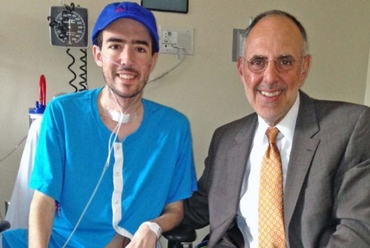
Greg’s nominee, Peter DeComo, faces a much more formidable set of foes — the FDA and the Department of Homeland Security.  DeComo’s Hemolung Respiratory Assist System might save people’s lives while they wait for lung transplants.  But if DeComo’s company, ALung, fails to fill out the equivalent of a 27B/6 Form, you’ll have to die rather than risk using an unapproved device.  By overcoming the FDA and Border Guards from Central Services to save a life, Peter DeComo has significantly improved the human condition, done so with insufficient recognition, and succeeded in the face of powerful opposition.  That makes him worthy of “The Al.”

As Matt likes to remind us, the movie Brazil is increasingly looking like a documentary rather than a work of fiction.