(Guest Post by Matthew Ladner)
MaryEllen McGuire of the New America Foundation takes on the unions for dealing out the least experienced teachers to the neediest children in U.S. News and World Report:
Teachers with the least experience are educating the most disadvantaged students in the highest poverty, most challenging schools. Low-income kids are being “triaged” not by experienced teachers, but by those with fewer than three years of teaching to go on.
Does it matter? Absolutely. According to the research, teacher experience is at least a partial predictor of success in the classroom and, at present, one of the only approximations for teacher quality widely available. Experienced teachers tend to have better classroom management skills and a stronger command of curricular materials. Novice teachers on the other hand struggle during their initial years in any classroom.
McGuire’s point is valid, but of course we should not be content to use experience as an approximation for teacher quality. There are both outstanding young teachers and truly awful experienced teachers, as you might recall from the Son of Super Chart:
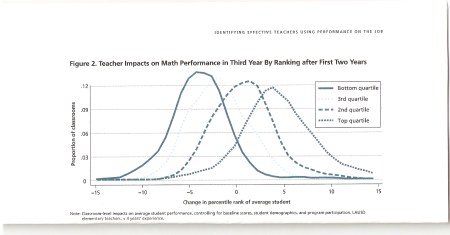
The Son of Super Chart broadly backs up McGuire-the curve for 1st year teachers is centered on -5, and the curve for 3rd year teachers on 5. All else being equal matching inexperienced teachers with high needs kids is an abominable practice.
Of course, all else need not be equal, which is why Teach for America works well.
McGuire proposes solutions:
Once we can wrap our heads around the true extent of the problem we can start taking down the second obstacle: figuring out a way to entice more experienced teachers to teach in high need schools. This will require a long-term commitment to systemic reform including investing in low-poverty schools to make them more attractive teaching placements and funding incentives to initially attract experienced and, we hope, higher quality teachers to low-income schools.
Will this require dollars beyond what we have? Not necessarily.
Federal law already provides schools with money to pay for this. It’s just that the funds typically go to reduce class sizes or provide professional development for teachers instead – strategies that have mixed results. Some of these funds should be redirected to pay for incentives drawing teachers into high-poverty schools. This is also a great use of stimulus money.
I’m glad to see to someone from the New America Foundation describe the results of class size reduction as “mixed.” Wow- you are half way there. The real word you are looking for however is “c*a*t*a*s*t*r*o*p*h*i*c” and the issue goes much deeper than the distribution of experienced teachers. On average, American colleges of education are recruiting from the bottom third of American college students based on admission scores.
Reading between the lines, the world is precisely as the unions want it to be: an emphasis on class size and seniority over teacher quality or equity. The system is also perfectly designed to deliver the most needy students low-quality teachers.
John Rawls is surely spinning in his grave.
UPDATE/CORRECTION
I loaded the wrong Brookings study Super Chart! The correct Super Chart! is from page 28 of the same study and shows a weaker relationship between experience and student learning gains, with year one teachers with a bell curve centered around -3 and second and third year teachers around zero.

 Jay P. Greene's Blog
But Matt, I thought unions weren’t an obstacle to reform. What about the Massachusetts miracle?
The Massachusetts what?
Fer gosh sakes, getting the teachers to work at lousy schools is easy – auction the jobs off. The problem comes with qualifying the bidders. Since there are no objective measures of teacher quality there’s no way to determine which teachers are good enough to teach at lousy schools. Simply assuming experience equates to teaching ability is putting a great deal of weight on a thin reed since tenure obscures the value of experience.
Unmentioned is the importance of having a good principal running the school since a lousy principal can dissipate the efforts of a school full of good teachers.
If unions have any influence in hiring and placement of teachers, then schools are operating in a vacuum of administrative leadership, and communities should demand higher standards from the people who run their schools – the union is their to collectively bargain a contract – not decide hiring and placement practices.
Sorry Mike but the union’s there to get the best possible deal for their members and that includes usurping as much of management’s prerogatives as possible.
Given that school board membership is a political office and unions have shown no hesitation about running members for those offices it would seem to me that the inevitable conflict of interest might easily result in the administration being hamstrung by the people they report too. Under those conditions how do you propose to fill that vacuum of administration leadership? Recruit great white sharks as school superintendents?
But, Allen, an effective administrator – the likes of which are common at the nation’s top schools – would not let management decisions be “usurped.”
Michelle Rhee has been pretty shark-ish. So was Arne Duncan in many ways. The superintendent in Bellleveu certainly isn’t manipulated by the Union. Neither is the one at New Trier or Dallas or Scarsdale or Cherry Creek.
The vacuum is there – my point has always been that the finger pointing happens too far down the ladder.
Michelle Rhee’s success is still a prediction, Arne Duncan’s reign over the Chicago school system hardly resulted in a striking break with the dismal results of the past all the brass-band histrionics notwithstanding. As for the others, my observations don’t preclude excellent performance across an school district. I’m just pointing out that the structure of public education, specifically the school district, mitigates against excellence making mediocrity as much as can be expected except in extraordinary circumstances.
The most common of those extraordinary circumstances is lots of rich parents.
Not, I hasten to add, lush budgets although rich parents will result in lush budgets but it’s the rich parents that make the difference since there are school districts with lush budgets but lacking in rich parents. Kansas City, MO is one famous example and Detroit’s a pretty close runner-up.
Rich parents have the education, the means and the attitude to square off against a union-endorsed candidate and win. So a district rich in rich parents is less likely to long suffer the results of a union-dominated school board or an indifferently-run school board the a district with a less-wealthy group of parents.
> The vacuum is there – my point has always been that the finger pointing happens too far down the ladder.
Too far down the ladder for who? You?
As a teacher you’re the lowest-paid professional in the organization and the bottom of the org chart. Do you expect the principals or the superintendents to nobly step forward and accept the blame for the lousy performance of the school or district? Would you?
If you want your skills to be appreciated you work for an organization that rises or falls on the efficient use of those skills. Public education, in case I’m being to oblique, isn’t one of those organizations since no one, not the teacher’s, principal’s, superintendent’s or school board member’s, fortunes depends on the educational efficiency of the organization.
Coincidentally, an example of what Arne Duncan left behind – http://tinyurl.com/lqgkvo. Not necessarily proof of the man’s incompetence but definitely not a proof of his shark-like managerial ferocity.
I work for an organization that appreciates my skills in a myriad of ways, Allen. Limiting the terms of “appreciation” to monetary compensation is only one of the ways that you misunderstand public education.
That misunderstanding is pretty widespread phenomenon Mike.
It springs from an admixture of the endless demands for higher pay/better bennies/more funding, the avidity with which counter-productive and unintelligible edu-fads are embraced and the desultory educational results that are inevitably the fault of everything and everyone *but* the public education system.
As for the appreciation of your skills, who’s the best teacher in your school? In your district? Who’s the highest-paid teacher in your school? In your district? Does skill and the most mundane measure of appreciation – pay – match up to any degree? Can you say, using some objective measure, which teachers are more skillful and which teachers are less skillful then yourself?
You know the answers as well as I do although your claim that your skills are appreciated in a myriad of ways pretty much makes it inevitable that you’ve chosen to blind yourself to the fact that your skills aren’t appreciated, at least not by the organization that employs you.