(Guest Post by Matthew Ladner)
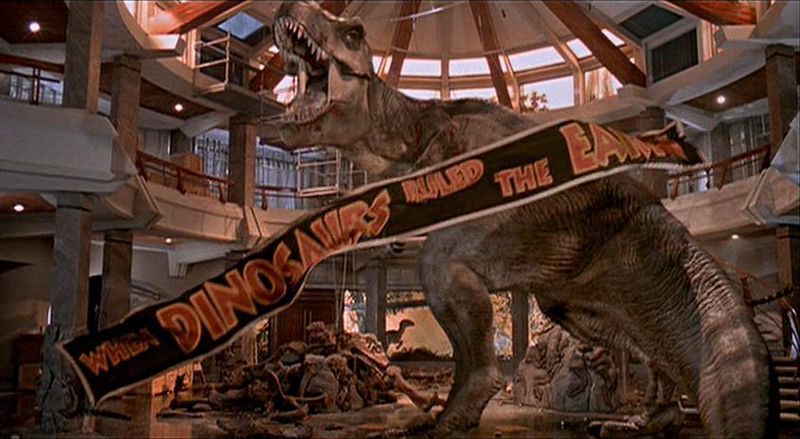
The ending sequence of Jurassic Park represents one of the great cinematic thrills of the 1990s. For those of you who couldn’t bear to watch, Drs. Grant and Sadler, et al, found themselves running for their lives inside the Jurassic Park compound, followed by a nasty group of foolishly resurrected velociraptors. The raptors had our heroes surrounded, when suddenly a Tyrannosaurus-Rex appeared to chomp one of the raptors, allowing our human protagonists to slip away. The T-Rex and surviving raptor battled it out. After disposing of the raptor, the triumphant T-Rex bellows out a roar so loud that the overhanging “When Dinosaurs Ruled the Earth” banner to dramatically flutters to the floor.
Now, for you incurable skeptics wondering how the T-Rex got into the building, how it approached with such stealth despite being large enough to shake the ground from far away earlier in the film, etc.- just stop it. It’s a popcorn movie, after all. You didn’t even realize you wanted to see T-Rex vs. velociraptors, but Steven Spielberg did and he delivered the goods.
It’s exciting to watch the future of education unfold, made all the more so by an appreciation of just how dysfunctional our schools are in the present. In 2006, a blue-ribbon panel delivered a scathing indictment of the American public education system. The panel, called the New Commission on the Skills of the American Workforce, included a bipartisan mix of the great and good, including two former secretaries of Education and an assortment of other grandees.
“If we continue on our current course, and the number of nations outpacing us in the education race continues to grow at its current rate,” the report states, “the American standard of living will steadily fall relative to those nations, rich and poor, that are doing a better job.”
The commission has come up with a variety of (IMO) ideas of varying quality, some of which sound misguided (expanding pre-school to 3 year olds) and others that sound outlandish but deserve a hearing, with still others falling into the “no-brainer” category (merit pay).
“We’ve squeezed everything we can out of a system that was designed a century ago,” Marc Tucker, vice chairman of the New Commission on the Skills of the American Workforce told the Christian Science Monitor. “We’ve not only put in lots more money and not gotten significantly better results, we’ve also tried every program we can think of and not gotten significantly better results at scale. This is the sign of a system that has reached its limits.”
“I think we’ve tried to do what we can to improve American schools within the current context,” Jack Jennings told the CSM. “Now we need to think much more daringly.”
The Jurassic angle on all of this has been the reaction of the T-Rex of the education policy world: the teacher unions. T-Rex was none too fond of the report.
Antonia Cortese, executive vice president of the American Federation of Teachers told the New York Times that the report contains “some seriously flawed ideas with faddish allure that won’t produce better academic results.” My favorite line, however, came from Reg Weaver, the president of the National Education Association, who urged “caution in calling for drastic changes.”

Hello failed status-quo, meet my pal- the future!
Given the huge percentage of American 4th graders who can’t read, and the large percentage of high-school students dropping out, by all means, let’s be very, very cautious in making any drastic changes.
Don’t get me wrong: caution in making policy changes is a good idea, an underlying principle of conservative thought. Caution in the face of extreme and blaring need for change, however, moves one from the realm of being a conservative to the realm of being a full blown reactionary. The latest NAEP test of reading shows 59 percent of African American and 56 percent of Hispanic 4th graders scoring “below basic” on reading in 2005. Unable to read their texts, huge numbers of these same students will begin to drop out of school within the next five years. We haven’t exactly achieved great return on investment for spending beyond the dreams of avarice for a school administrator from the 1960s.
Unfortunately, the report did not emphasize school choice. It should have. Chubb and Moe had a pretty decent explanation for the failure of public schools: their monopoly on students promotes and enables them to away with it.
Just for fun, go to http://www.greatschools.net and call up a list of every high school within 30 miles of the 85028 zip code. This zip code is in North Central Phoenix. You’ll get a list of 200 high schools from all over the greater Phoenix area. Next rank the schools according to their performance on the Terra Nova reading exams. Charter schools comprise nine of the top ten schools. Rounding out the top ten is a magnet school. In other words, all of the top ten high schools are schools of choice. Not a single traditional district school makes the list despite the existence of plenty of wealthy suburban schools.
This is progress my friends, and we need much, much more of it. Dinosaurs have ruled the education earth for too long.

 Jay P. Greene's Blog
[…] Ladner from Jay P. Greene’s Blog is urging us all to escape from Jurassic Schools and the T-Rex of the education policy […]