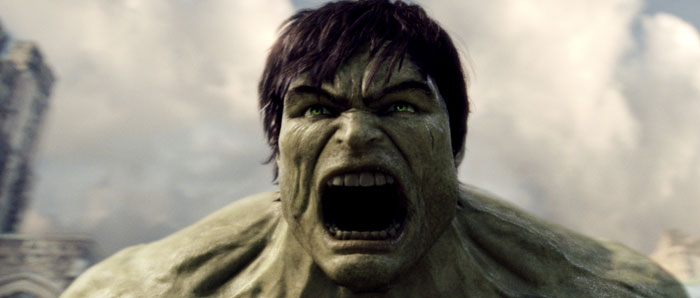
“I’m Gumby, dammit!”
(Gen Y readers see here for explanation.)
With no Lost episodes until at least the fall – the network isn’t saying when it’s coming back; my guess is they put the whole show into “The Vault” and transported it forward in time, so who knows when it will reappear – the weekly Get Lost feature is going on summer break and we’re starting a new Friday distraction called Pass the Popcorn.
Before moving on to new business, I’d like to report that to my very great surprise, my 12,000 line epic poem on the virtues of Speed Racer generated no negative reaction whatsoever – because it turns out I’m the only person on earth who has seen the movie.
One week from today, Marvel will unveil the latest attempt to make an Incredible Hulk movie that doesn’t suck. As all geeks and fanboys know only too well, in 2003 the career of one of the greatest filmmakers of the 1990s, Ang Lee, shipwrecked on the rocky shoals of the big mean green machine.

“I agreed to make a Hulk movie? Oh, please . . . please, no!”
It’s worth contemplating the significance of Lee’s failure. Here was a man who was perfectly positioned to make a great movie out of the Hulk. After establishing himself with his intimate portrait of family and romantic relations, Eat Drink Man Woman (1994), he turned out two of the most noteworthy movies of the decade, each of which achieved serious commercial success while retaining the deep emotional sensibility of the arthouse: Sense and Sensibility (1995) and Crouching Tiger Hidden Dragon (2000), in addition to his less widely noticed but still artistically important indictment of the sexual revolution, The Ice Storm (1997). His masterpiece, Sense and Sensibility, can make a fair bid to have been the best movie of the 1990s. Why should Emma Thompson get all the credit – sure she produced what is probably the best film script adaptation of a novel ever, but Ang Lee directed the darn thing.
Though the choice of an “arty” director to produce a Hulk movie seemed daring and risky at the time, and was thus interpreted in hindsight as a huge blunder, I don’t think that was the problem. Lee’s movies may have been “arty,” but not in an obscure way. They’re completely accessible to non-specialist viewers. Lee was always concerned to connect with a broad audience. And his gift for communicating the emotional lives of his characters should have served him very well in making a movie whose central plot device hinges on the emotional state of the main character. Moreover, with Crouching Tiger, Lee had already demonstrated a mastery of the art of fantastic narrative.
Alas, during the same period as his triumphs, he also produced Ride with the Devil (1999). It was dismissed at the time as a mere one-time stumble for an otherwise successful director, but perhaps it may now appear as a harbinger of trouble to come.
Lee’s downfall with the Hulk, I think, was his decision to experiment. His previous movies, though arty, were by and large not experimental. Yes, people flew in Crouching Tiger, but that was nothing new; Lee was building on a long tradition of visually fantastic martial arts movies. Lee and his team certainly advanced the technology of these movies in important ways – nobody had ever run up a wall quite that convincingly before – but they were building on an established genre of visual presentation.
But his critical and commercial success, combined with the big franchise he was handed, appears to have prompted the onset of hubris. Lee notriously decided that the visual presentation of his Hulk movie would be comic-style; that is, multiple views of the action would appear on the screen simultaneously, in rectangles vaguely reminiscent of comic book panels. This might have worked, if Lee had done it right; the TV show “24” has done great things with split-screen presentation – and without the benefit of the big movie-theater screen. But Lee was so busy with his panels that he forgot to use them for anything worth having them for. We got multiple views of things that didn’t reward multiple views – Dr. Banner fiddling with the switches on his big fancy science machines does not get any more interesting when you see it from different angles. And I think this fascination with form to the exclusion of content was the major reason the movie failed (though the weak script and other problems didn’t help).

“Just sit still, Mr. Norton, and this machine will painlessly remove your desire to appear in a Hulk movie.”
After his demolition at the hands of critics and audiences alike, Lee abandoned the mainstream and ran screaming back to the arthouse from whence he had come, producing (in 2005) a movie about gay cowboys – thus ensuring his restoration to the good graces of the Hollywood illuminati, and giving new life to a priceless gag about the obscurity of arthouse films from a 1998 episode of South Park.

“These are independent films.”
“You mean like ‘Independence Day’?”
“Naw dude, ‘independent films’ are those black and white hippie movies. They’re always about gay cowboys eating pudding.”
Now Marvel is trying again, and this time it’s not letting anyone else spoil the Hulk – this time Marvel is going to spoil the Hulk for itself. (If you want something done right . . .) Though it’s being distributed by Universal, the movie was produced entirely by Marvel’s new movie production unit Marvel Studios. Iron Man was the unit’s first major film project, and obviously it’s off to a great start both artistically and commercially. So naturally they decided their second project needed to be abysmally bad, to balance the cosmic scales.
No, I haven’t seen it, but I’ve seen the trailer, and that’s more than enough. Edward Norton certainly looks like he does a good enough job in the role. But take a look at the new “Hulk”:
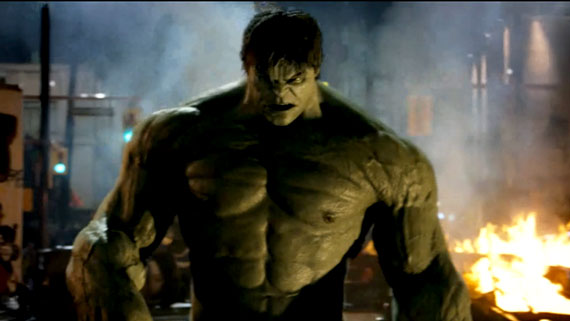
I mean, there’s a lot more to a good summer movie than special effects – but if the special effects look lousy, then the whole time we’re sitting there watching, we’re going to be constantly thinking about the fact that we’re watching a special effects movie with lousy special effects. In other words, no amount of great story, witty dialogue, etc. is going to overcome the fact that people will be sitting there looking at the Hulk and thinking, “Man, that thing looks so much like a clay figurine, I keep expecting Pokey to wander onto the screen.”
And for the big finale, the claymation Hulk battles – another claymation Hulk! It’s better than having him fight a magic tornado, or whatever that was at the end of Lee’s movie. But still. Did you notice that the only weak part of the Iron Man movie is where the good Iron Man fights the bad Iron Man? What’s up at Marvel Studios – did they play too many games of Mortal Kombat and decide that every movie must end in a Mirror Match? (Come to think of it, the new Hulk doesn’t just look like Gumby on steroids; with that disproportionately tiny head, he looks like Gumby and Goro’s love child.)
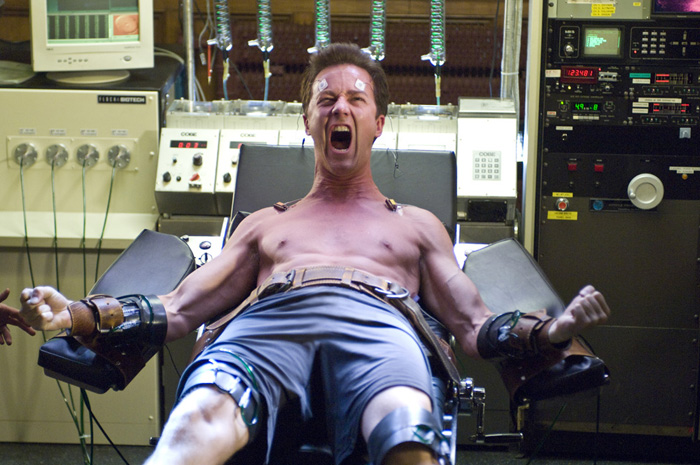
“Get me outta this friggin’ movie!”
So what is it about the Hulk? Is he unfilmable? Cursed? Maybe it’s a problem, not an advantage, that his superpower is so bound up with psychology. In comics, it’s remarkably easy to shift the tone of the story; that’s one of the inherent advantages of the medium. So you can have a big fight scene immediately followed (or, more likely in the case of the Hulk, immediately preceded) by an intimate emotional scene. On screen, though, it’s harder to shift tone at such a rapid pace. The sound and the fury of the big fight scenes drown out everything around them. That may also explain why the TV Hulk wasn’t an embarrassment – TV can switch moods better than film (although still not as well as comics), and in those low-tech days there were fewer highly intense “effect” scenes and the ones they did have were less intense. For that matter, the Hulk himself wasn’t an “effect,” and that alone may have been the key.
Tune in next Friday for another look back at a talented filmmaker ruined by success: M. Night Shyamalan.

 Jay P. Greene's Blog

Your comments on bad special effects remind me of the second Mummy movie. Everything was humming along fine until the Rock’s character the Scorpion King appeared. Or rather, a computer generated animation piece whose head barely looked like the Rock. I said to myself “Did they just run out of money to put something so obviously pathetic on screen?”
I also got suckered into seeing the Beowulf movie without knowing it wasn’t a live action film, but rather a piece of animation. I was bent- it was like watching Shrek the Viking King. Supposedly it was much better in IMAX 3-D, but that didn’t do me any good.
Bring back Lou Ferigno and the green paint baby!
Yes, I think “Bring Back Lou Ferigno” is the takeaway from this post. Although they brought him back for a cameo in Ang Lee’s movie and that still didn’t save it. 🙂
In order for M Night Shyamalan to have been “ruined”, he would have to have been good to begin with. You’re promising false premises here.
The had Iron Man fight the Iron Monger in his movie because that’s the most iconic Iron Man villain. The amount of time it would have taken to explain magical ring wearing ninja chinese people or giant face for a body floating chair people would have eaten an entire movie.
At the same time, the Abomination is a pretty iconic Hulk villain. Everything that is right about the Hulk is wrong about the abomination, he’s the excuse needed to justify letting a giant green man in purple pants run around your city without a nursemaid.
The new Hulk movie isn’t that bad at all. The cardboard acting of horse-faced Betty aside.