Nominees for the Al Copeland Humanitarian of the Year Award — Steve Henson

October 13, 2009


We here at JPGB are proud to announce nominees for the Al Copeland Humanitarian of the Year Award.  The award is meant to honor a person who has made a significant contribution to improving the human condition. 

The criteria of the Al Copeland Humanitarian of the Year Award can be summarized by quoting our original blog post in which we sang the praises of Al Copeland and all that he did for humanity:

Al Copeland  may not have done the most to benefit humanity, but he certainly did more than many people who receive such awards.  Chicago gave Bill Ayers their Citizen of the Year award in 1997.  And the Nobel Peace Prize has too often gone to a motley crew including unrepentant terrorist, Yassir Arafat, and fictional autobiography writer, Rigoberta Menchu.   Local humanitarian awards tend to go to hack politicians or community activists.  From all these award recipients you might think that a humanitarian was someone who stopped throwing bombs… or who you hoped would picket, tax, regulate, or imprison someone else.

Al Copeland never threatened to bomb, picket, tax, regulate, or imprison anyone.  By that standard alone he would be much more of a humanitarian.  But Al Copeland did even more — he gave us spicy chicken.”

With that introduction, I would like to present the following nominee for the Al Copeland Humanitarian of the Year Award — Steve Henson, the inventor of ranch dressing.

Brian Kisida has submitted this nomination with the following support:

Like the man who the Al Copeland Humanitarian of the Year Award is named after, this year’s first nominee has also benefited humanity by stimulating our taste-buds.

The first nominee for 2009 is: The creator of ranch dressing, Steve Henson!  

Steve and Gayle Henson opened the horseback-riding tourist attraction Hidden Valley Ranch in Santa Barbara, California in 1954.  One of the things guests at the ranch enjoyed was a special salad dressing Steve developed, and soon visitors were being sent home with to-go bottles of the tasty goodness we have all come to love.  After starting a side business for the sole purpose of manufacturing his invention, Steve sold the recipe to Clorox for $8 million in 1972.  At this time Hidden Valley Ranch was nothing more than a packet of seasoning that consumers had to mix with mayonnaise and buttermilk.

It wasn’t until the 1980’s that a non-refrigerated formula hit grocery store shelves in bottle form, and by 1987 the emergence of Cool Ranch Doritos signaled just how far Steve’s recipe had come.  In 1992, ranch overtook Italian and remains the nation’s top-selling salad dressing.

Today, ranch dressing is not only the most popular salad dressing, its pervasiveness as an all around condiment is nearly unmatched.  It’s splendid as a dip for fresh vegetables, fried vegetables, French-fries, and chicken-wings.  And it’s not uncommon for ranch to add some zing to baked potatoes, hamburgers, and even pizza.  In fact, I dare you to think of something that isn’t better with ranch.

Thank you Steve Henson, for the gift you have given to all of humanity. 

(edited for clarity)


One Stop Special Ed Voucher Info

October 13, 2009

I know, I know.  I’ve been writing a lot recently about special ed vouchers.  But if you’ve missed it or are just looking for a convenient one-stop place to get the latest info, arguments, and evidence on special ed vouchers, check out the piece Stuart Buck and I wrote for the current issue of Education Next.  It’s filled with links, so it should be a useful resource for anyone interested in special ed vouchers.


Happy T-1 Peoples Day

October 11, 2009

Controversies surrounding the celebration of Columbus Day raise a number of interesting questions.  Unfortunately, many of the new answers offered are at least as simplistic and historically false as the established answers they are meant to replace. 

It is true that Europeans confiscated land on which other people lived, sometimes intentionally killed those people through war or disease, and more often unintentionally killed those people with disease (this was, afterall, before the development of the germ theory of disease or any practical means to control its spread).

While there is no doubt that Europeans confiscated land in the Americas from other people, we almost always fail to ask how those people came to possess that land.  We regularly refer to the people from whom Europeans confiscated lands as Indigenous Peoples or First Nations, but those terms are clearly inaccurate. 

Indigenous means “having originated in and being produced, growing, living, or occurring naturally in a particular region or environment” and first is defined as “preceding all others in time, order, or importance.”  Neither term correctly describes the connection between the people whom the Europeans displaced and the land from which they were displaced.  Those peoples neither “originated” from nor preceded “all others in time” on that land.  Instead, those peoples confiscated that land from other groups of people who preceded them, often through war and disease.  And those displaced people confiscated the land from people before them, and so on.

It would be more accurate to describe the people from whom the Europeans confiscated land as the “T-1” Peoples because they were the people in possession of the land in the prior time period.  And those T-1 Peoples confiscated the land from T-2 Peoples, who in turn took it from T-3 Peoples, etc….

This all raises some very messy and complicated questions about how a People can have a legitimate claim to a land.  You can’t just declare that history starts whenever it suits you.  Being a T-1 People does not make them the “first” or “indigenous.”  There was a history before that with its own prior claims of ownership.

Just to illustrate this messiness — much of the land around the Dakotas was in the possession of a group of Sioux known as the Lakota when large number of European descendants arrived in the area.  The struggle between these European-Americans and Lakota culminated in the massacre of Lakota at Wounded Knee and their confinement to reservations.  This chain of events was filled with suffering and cruelty inflicted on the Lakota and has been cited by activists to justify claims of expanded control over land in that area by the Lakota descendants. 

But how did the Lakota come into possession of that land before large numbers of Europeans arrived?  The Lakota can be traced to the Great Lakes area (and almost certainly came from somewhere else before that).  They were pushed west by the Ojibwe as the Ojibwe were pressured by the westward expansion of the fur trade.  The Mandan and Hidatsa blocked the Lakota from crossing the Missouri river, but eventually their resistance was weakened by disease and the Lakota were able to conquer the grassland in the Dakotas.  In doing so they also pushed west the Shoshone, who were struggling for that same valuable grassland.

So, who has the rightful claim to that land?  Is it the Lakota, because they were in possession of it before large-scale arrival of Europeans?  What if descendants of the Shoshone, Mandan, or Hidatsa showed up, could they legitimately claim the land as their own?  What about the descendants of the various peoples who preceded all of these groups?

Only simple-minded college students and slogan-shouting activists could say that Europeans stole that land from the indigenous people, massacred its people, and ought to give it back.  The problem is that all land has been stolen countless times, with round after round of massacres, and an endless string of confusing claims to rightful ownership.  Being the T-1 People is hardly a sufficient justification for the legitimate possession of land. 

If college students want to think seriously about these issues, they should discuss multiple, practical criteria for legitimate ownership of land, which might make them appreciate some of the messy compromises that explain status quo arrangements.


More Humanitarian of the Year Awards

October 9, 2009

 
At first I thought it was a joke, but no… the Nobel Peace Prize was awarded to Barack Obama.  He can now join unrepentant terrorist, Yassir Arafat, and fictional autobiography writer, Rigoberta Menchu,  in having received that honor.
 
Regardless of what one thinks about President Obama’s strategy for producing greater world peace, I think all can agree that it is a strategy that has yet to produce meaningful results.  It seems quite strange that the Nobel Peace Prize has gone to someone who hopes to produce peace without having achieved much of anything in the way of actual peace. 
 
There’s been no change in the situation with regard to Israel and the Palestinians.  There’s been no (positive) change with respect to Iran’s nuclear ambitions (and there have been some considerable negative developments). The situations in Iraq and Afghanistan have deteriorated significantly over the last year.  Other than a bunch of speeches, what good has actually been accomplished?
 
I just have to repeat that Al Copeland, the founder of Popeye’s Chicken, is more worthy of this kind of prize.  At least he actually did something to improve the human condition — like give us spicy chicken.

Showdown to go nuclear

October 6, 2009

(Guest Post by Matthew Ladner)

Fascinating analysis from Stratfor.com (you can sign up for free content) makes the case that it is almost showtime on the issue of Iranian nuclear weapons

The Israelis have presented evidence to the Russians of Russian scientists being deeply involved in the Iranian bomb development program. It looks like what is being set up here is a red pill/blue pill scenario where the Russians will either have to support crippling sanctions or Israel and/or USA will take action on their own. You take the red pill, and we try sanctions. You take the blue pill, and we’ll see how much bombing the Iranians can take.

Given that much of the Iranian people already hate their regime with a well-deserved purple passion, why not try an intermediate approach? The U.S. Navy could blockade the Persian Gulf for Iranian oil shipments, and announce that the Iranian people have a set amount of time to accept U.N. weapons inspectors before a catastrophic bombing campaign begins aimed at not only destroying any nuclear capacity but also the Iranian military.

The President could tap the Strategic Oil Reserve here in the United States to ease the pain. The Iranian economy and body politic would be thrown into chaos, and there would be a chance that the Iranian military would make a rational decision regarding self-preservation.

If we had to bomb anyway, no one could say that President Obama failed to go the extra mile to avoid war.

For those of you who are instinctive multilateralists, don’t forget that Iran signed the Nuclear Nonproliferation Treaty. If such treaties are to have any meaning, they must be enforced.


Our Tax Dollars Paying for Penuchle

October 5, 2009

(Guest post by Jonathan Butcher)

Boy, does this sound familiar!  Apparently, the U.S. Post Service shells out $1 million every week to “pay thousands of employees to sit in empty rooms and do nothing.”  Mail volume has slid 12.6% compared to last year, and the Post Office simply can’t find enough to do to keep postal workers busy.  “So they sit — some for a few hours, others for entire shifts…They spend their days holed up in rooms — conference rooms, break rooms, occasionally 12-foot-by-8-foot storage closets…”  Funny, this reminds me of grad school (without the free food).

The employees can’t be fired due to union rules, of course.  Not only that, but workers at slower post offices can’t even be reassigned to busier locations.

Why does this sound familiar?  Because teacher union rules in New York City created something remarkably similar.  As The New Yorker pointed out recently (and noted on jaypgreene.com here) , teachers unions have some 600 teachers in the city sit in “rubber rooms,” playing cards, chatting, or fighting over folding chairs.  These teachers get their summers off and are getting paid their full salary (in some cases upwards of $100,000 a year).

Unlike the postal workers, the issue with these teachers in a holding pattern is that they are under investigation for misconduct or incompetence.  But the fact remains that unions in both cases make it virtually impossible to fire anyone, the knights of the folding chairs still get paid a full salary, and they are all doing absolutely nothing for months on end.

Our tax money, funding penuchle games for federal and state employees everywhere.

(HT: Carpe Diem)


The Obama Administration to Date

October 4, 2009

This just about sums it up — that is zero-sums it up.


Pass the Clicker: John Adams

October 2, 2009

Adams

(Guest post by Greg Forster)

Recently I finally got around to watching the HBO mini-series John Adams. It’s very good and you should watch it!

But I think this material would have been better as, say, three or four separate movies rather than one long story. Because three or four separate stories is pretty much what you’ve got here. There is some overlap, especially between Adams’s political career and his marriage. But the multiple storylines would have come out better if we’d been able to focus on one at a time.

I’ve increasingly come to think that the “biopic” is a poor format for storytelling, becasue no human life meets the demands of narrative structure perfectly enough. Instead of focusing on “the life of John Adams and the big stories that he saw,” what you want is to tell each of the stories.

Adams & Washington

One of the stories is about Adams’s political career, and here you have the makings of both classical tragedy and triumphant epic rolled up into one narrative. Tragedy, in that Adams had the makings of a great statesman but he was constantly undermined by his own vanity and stubbornness. Triumphant epic, in that he repeatedly disregarded his own self-interest to accomplish great things for his country. From his first significant political act (defending the innocent British soldiers falsely accused in the “Boston Massacre” case) to his last (keeping America out of an unnecessary war with Napoleon), he repeatedly chose to do the right thing in the teeth of extreme pressure from popular opinion and political interests alike.
Real Hamilton 1Hamilton 1

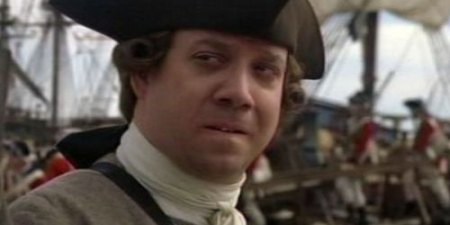
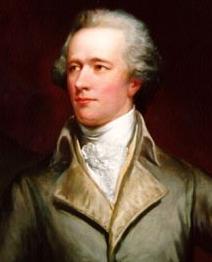
One story I especially enjoyed seeing was the gradual development and then explosion of the scorpions-in-a-bottle rivalry between Adams and his keep-your-friends-close-and-your-enemies-closer political ally, Alexander Hamilton. It’s a story I don’t think anyone else has ever taken a crack at on the screen, and it’s well worth seeing. I have to say Hamilton gets something of a bad rap in a show where our sympathies are meant to lie with Adams. But the exceptionally talented Rufus Sewell makes Hamilton into an effectively menacing villain.

John & Abigail

The second story, also combining triumph and tragedy, is Adams’s family life. Just his famous marriage to Abigail alone would be more that sufficient to carry a movie by itself, and Laura Linney’s outstanding performance matches Paul Giamatti’s step for step.


Real AbigailJohn & Abigail at meeting

Different productions have chosen different approaches to the John and Abigail relationship. The musical and movie “1776” went the cereberal route, depicting the relationship through the letters they famously exchanged (inevitable, perhaps, given that the story takes place while they were separated) with an emphasis on how these two equally sharp minds fenced and parried with each other.

John & Abigail alone

The HBO production, by contrast, periodically references Abigail’s intellectual impact on John, but focuses on two other aspects of their relationship. The first – and here is the overlap with the strictly political story – is the way she effectively tempered John’s fatal political weaknesses. When John and Abigail are living together, his ego is kept in check. She persuades him to minimize the rhetorical excesses of his defense speech in the Boston trial. She advises him to drop his extremely ill-advised campaign to add a quasi-royal honorific (“his excellency,” “his majesty,” etc.) to the presidency. But when they are apart, as they frequently are for extended periods, John’s demons keep rising to the surface.

The other focus is on John and Abigail’s role as parents, another story I don’t believe anyone has told on screen before. John’s stern insistence on controlling his children’s lives (especially his eldest son John Quincy) and his extended absences from the family both create extreme emotional burdens for Abigail and the children alike. As is well known, John Quincy turns out as well as his father, but we are made to see the dreadful price his father made him pay for it; as is not well known, his other children lived broken lives, his son Charles dying of drink and his daughter marrying a man with a tendency to lose money on speculation, and who ends up having to flee his bad repuation by moving west and starting over while his wife and children remain behind.

 Jefferson, Adams & Franklin

The third – and perhaps fourth, depending on how you count – story concerns the friendship and rivalry of Adams, Jefferson and Franklin. Here is where the series really shines; we see how these three very different men – Adams the blunt man of law, piety, and conservatism; Jefferson the quiet man of philosophy, romance, and radicalism; and Franklin the wry man of science, humor, and sensuality – at first become brothers bound by a common cause, and are then slowly but surely forced into opposition against each other by the divergent demands of their consciences. By far the two best scenes in the movie occur when Jefferson arrives in Paris, where Adams and Franklin have been serving as diplomats. Jefferson, after the deaths of his wife and child, is becoming cold and (even more) distant; Franklin and Adams have become rivals since Franklin felt he had no choice but to ask Congress to remove Adams from the French delegation due to his ineptness at diplomacy.
Real FranklinFranklin

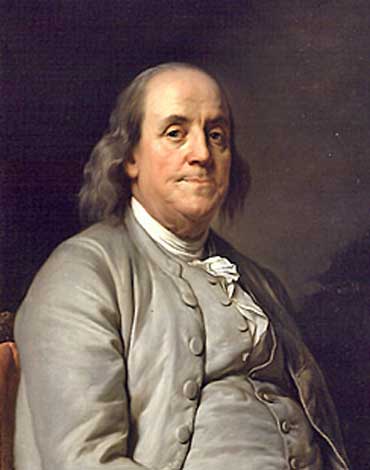
Tom Wilkinson absolutely steals the show as Franklin. It’s hard to make Franklin fresh to an American audience, but Wilkinson does it, aided of course by the scriptwriters.

You could count the Adams/Jefferson/Franklin friendship as either one or two stories, since Franklin’s death leaves us with only the famous Adams/Jefferson relationship on screen, and the dynamic changes. Meanwhile, the Adams/Franklin story is equally worth telling, and (yet again) a story I don’t think we’ve seen on screen. On the other hand, the rivalry that develops later between Jefferson and Adams isn’t dramatically interesting unless it’s preceeded by their friendship, and Franklin was central to that part of the story.

Real JeffersonJefferson

Regarding the later rivalry between Jefferson and Adams, the thesis of the movie is that Jefferson hardened his heart after the deaths of his wife and daughter, and this is what led him to shrug his shoulders and make excuses as the French Revolution became more and more barbaric, distrust his former friend Adams as a liar and a cheat when their disagreements over France became politically critical, and ultimately permit his retainers to print scandalous lies about Adams in order to secure his election in 1800. I have always preferred Adams over Jefferson, even before it was cool, but it must be said that this storyline, while it works as drama, is unfair to Jefferson. It is clear in the record that he recovered emotionally from his wife and daughter’s deaths, as his famous “dialogue between my head and my heart” love letter to a French lady shows pretty clearly.

The case against Jefferson was much more effectively made in the David McCullough book on which the HBO series is based. McCullough tells us that when Jefferson was born, he was placed on a pillow and carried out of the room by a slave, and “he was carried by slaves for the rest of his life.”

As Matt might say: BOOOOOOOM!

Someday, someone needs to make a movie of the Adams/Jefferson relationship. “Thomas and John” would make a great title. (Get to work on that, Hollywood readers.)

There’s so much more packed into this mini-series that I can’t hope to include it all. There are constant little touches history buffs will smile at and history novices will find intriguing – in fact, some of the eccentricities of the real historical characters have actually been softened so that they could be presented without seeming implausible. The stiff and uncomfortable formality of Washington, the shyness of Jefferson, and the eccentricity of George III have all been noticeably toned down so that they could be presented without the audience feeling like they had been exaggerated.

It will take a significant chunk of your time to watch it. And it is not thrill-a-minute stuff. But if you make the investment, you will be rewarded.

Especially if you plan to take the citizenship exam.


Jay & Marcus in NR

October 2, 2009

NR cover (Jay & Marcus article)

(Guest post by Greg Forster)

In the new National Review, Jay and Marcus review the research on special education funding incentives, including the findings of their recent study on the impact of vouchers in Florida.

Financial incentives are particularly important in low-level disability categories like SLD, where a diagnosis is easily fudged. While you need pretty solid evidence to diagnose a child with a traumatic brain injury or other severe disabilities, schools have plenty of leeway on SLD. Some research suggests that public schools use low achievement alone to serve as an indicator of SLD. Studies dating back to the 1980s found that SLD students are indistinguishable from low-achieving regular-enrollment students, with one study estimating that over half the students identified as SLD in Colorado did not fit either federal or state definitions for SLD.

Digital subscribers go here; paper-only subscribers go here; non-subscribers go here.


Car Buyers Hate Bailouts

October 2, 2009

The Homer

(Guest post by Greg Forster)

You, the taxpayer, spent billions of dollars bailing out Chysler and GM.

Great news!

GM’s sales are down 45% from last September (when sales were already bad enough to drive the company into banrkuptcy). Chrysler is down 42%. Ford is only down 5%. Car buyers are clearly punishing the two bailout recipients brutally. Robert Farago of Truth About Cars predicts that GM and Chrysler will both “go down by the end of next year” without a second, new federal bailout. The only question, he says, is whether the two bailed out manufacturers will need the cash before the 2010 midterm elections.

Why is that great news? Because maybe it will help a few legislators learn their lesson for next time.

HT Kausfiles