The John Stuart Mill approach to Health Care Reform

October 21, 2009

(Guest Post by Matthew Ladner)

JSM once noted that if government would simply require an education, that it might save itself the trouble of providing one. He could have added trying to provide one at enormous cost, but let’s not quibble over details.

This was the approach to the Romney reform in MA, but that reform ignores the fundamental problem with our system: third party payers create a powerful incentive to ignore costs. The Romney plan did not address this central problem.

If you don’t believe it, give me an unlimited line of credit with your money at a Vegas casino and watch me transform into a gambling fiend.

The New York Times published an important piece suggesting a brilliant compromise: the government should mandate insurance, but only catastrophic insurance.

This would introduce supply and demand back into most of the health care market, which is precisely what is needed in order to curtail costs and thus prevent the continuing loss of coverage (which is a symptom, not the disease).

Government policy (both in the tax code and from Medicare and Medicaid) is directly responsible for the out of control costs we have experienced. Having quasi-socialized the health care system but without gaining monopoly power to dictate terms to health professionals, politicians have created a culture of “anything goes” in health care.

Paul Tsongas said it best “America is the only country that pretends that death is optional.”

The government, in essence, has created a health care culture which rejects the very essence of a government run plan, which is bureaucratically rationed care. Notice the scrambling to pretend that there are “no death panels” in the plan kicking around Congress. This is of course meaningless, as if there are no death panels there soon will be under a new name: Eurocare is all about having bureaucrats make cost/benefit decisions about health care. They withold treatment to 78 year old men with prostrate cancer so they can spend their limited resources on prenatal care.

Forget about arguing the ethics of Canadacare: after decades of anything goes Americans won’t go for it. If the Democrats pass it anyway, they are likely to rue the day. Put in death panels = driving off a cliff. Expanding coverage without rationing and death panels = faster fiscal suicide.

We’re caught in a trap…can’t walk out!

It seems to me then that some sort of catastrophic mandate/increased out of pocket expenses/health savings account approach outlined in the Times article far more profoundly sensible than the fiscal/political suicide pact currently under discussion.

Munchausen by proxy syndrome in health care might have been great fun for the politicians while it lasted, but with a $1.4 trillion dollar deficit this year, we can no longer afford it.


Getting Less for Less

October 20, 2009

Hawaii decided to fix their budget shortfall by eliminating 17 days from this school year in exchange for an 8 percent reduction in teacher salaries.  That means Hawaii public school kids will spend 163 days in school compared to about 180 for most kids nationwide.

Eighty-one percent of all teachers approved the deal, which leaves “teacher vacation, nine paid holidays and six teacher planning days … untouched.”  Teacher benefits, including pension and health benefits also remain unchanged. In addition, “[t]he new agreement also guarantees no layoffs for two years and postpones the implementation of random drug testing for teachers.”  

So, teachers work 9.4% fewer days for 8% less pay, full benefits and two more years of guaranteed employment.  It’s not a bad deal… as long as you are a teacher.  Kids will be shortchanged, parents have to scramble for daycare, and the state gives away more than it gets in savings.

The only risk for the teacher union in doing this is that we might discover that student achievement is unaffected by 17 fewer days of school.  If that’s the case why not cut 34 days of school for 16% less pay?  Or maybe get rid of it altogether.


Mary Quant — Nominee for the Al Copeland Humanitarian of the Year Award

October 19, 2009

There is a common theme in who has been selected to be nominated for the Al Copeland Humanitarian of the Year Award.  For the most part, the nominees have, like Al Copeland, done something to improve the human condition by improving our material pleasure.  Steven Henson gave us delicious ranch dressing.  Debrilla M. Ratchford saved our aching backs by developing the roller bag.  Ralph Teetor gave us the smooth ride of cruise control.  Only Fasi Zaka distinguishes himself from the other nominees in that he was nominated primarily for his contribution to liberty by ridiculing tyrants.

Our next nominee, Mary Quant,  has improved the human condition both by adding to our material pleasure and by promoting liberty.  Quant is credited with the invention of the miniskirt.  She also popularized hotpants and patterned leggings

The contribution of these inventions to material pleasure requires no explanation.  But unlike Henson, Ratchford, and Teetor who primarily sought to improve material pleasure, Quant was also seeking to expand liberty.  Women’s clothing has often been designed to confine women — to limit their liberty by limiting their ability to function in the world. 

Quant wanted to do more than decorate women, she also wanted to liberate women to be able to participate fully in the world.  As the Wikipedia entry puts it, Quant saw the miniskirt as “practical and liberating, allowing women the ability to run for a bus.”

And if you don’t think women’s clothing can be an assault on liberty, how about the requirement in many Islamic societies that women wear burkas?  Imagine running for the bus in this.

(ht Brian)

(edited for clarity)


William Higinbotham – NOT Nominated for Al Copeland Humanitarian

October 19, 2009

William Higginbotham

(Guest post by Greg Forster)

In our ongoing process of gathering nominees for the Al Copeland Humanitarian of the Year award, last week Jay nominated Fasi Zaka on grounds that ridicule of dictators (actual or aspiring) is an important part of mankind’s struggle for freedom.

Well, another important part of the struggle is serious condemnation. We must indeed laugh at dictators, because you can’t effectively undermine their support without including that element. But we must also sometimes sober up and be serious about the threat they pose.

For that reason, I am announcing that William Higinbotham, inventor of the videogame, will not be nominated for Al Copeland Humanitarian of the Year.

First, let’s dive head-first into the deeply divisive historical controversy over the invention of the videogame. (And you thought we were brave to take on the issues surrounding Christopher Columbus!)

CRTamdev-preview

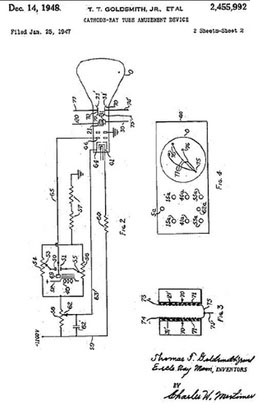
The first known electronic device created for gameplay was the Cathode Ray Tube Amusement Device (US Patent 2,455,992 granted February 1948) created by Thomas T. Goldsmith Jr. and Estle Ray Mann. The user twists a knob to guide a moving dot toward a target. But as it uses a non-representational display (rather than the graphical represntations implied by the term “video”) and is more a novelty skill test along the lines of a carnival “game” than a traditional “game” per se, it does not quite fit the meaning of the term “videogame.”

In March 1950 Claude Shannon published a program for a chess-playing game – but again without graphical representation.

NIMROD-players-prev

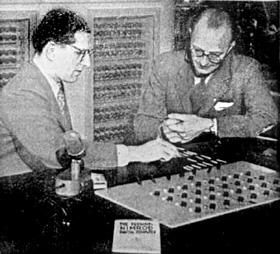
Next we get the NIM (aka “Nimrod”) computer, created by Ferranti International and presented at the Festival of Britain in 1951. It used a series of lights and buttons to play an ancient Chinese numerical game in which players manipulate “heaps” containing different numbers of objects; the player who takes the last object out of the last heap is the loser. Once again, without graphical representations we don’t yet have the “videogame.”

OXO_emulated_prev

Alexander Douglas’s tic-tac-toe program in 1952, designed as part of a Ph.D. thesis on questions of user interface design, almost gets us there. But while the display of Xes and Os on a board is a step toward graphical representation, it’s not strictly there yet – the Xes aren’t crude representations of some kind of X-shaped object, but symbols – not essentially different from the symbols chess players use to express their moves in letters and numbers. I’ll grant that the visual positioning of the symbols is an important step. But it’s not really a “video” game until you have graphical representation.

Enter, stage left, the genius of William Higinbotham. In 1958, he worked at the Brookhaven National Laboratories and often had to entertain guests waiting to take tours of the labs. To keep them occupied, he designed a tennis game (christened “Tennis for Two”) on one of the lab’s oscilloscopes.

Oscillosopes are all computer programs now, but my father used to have one of the old stand-alone units with the tiny little screen that showed waves going by. When I was a little kid he let me play with it – you could change the shape of the waves by turning the dials. I was endlessly fascinated by this. Here’s what a standard oscilloscope used to look like:

oscilloscope

And here’s what William Higinbotham got it to do:

tennis_for_two-prev

You turned a knob to change the angle of your shot and pressed a button to hit the ball – and entertainment was revolutionized forever.

tennispaddle

The modern videogame evolved into its final form with breathtaking rapidity – by 1961, MIT’s Stephen Russell led a team that created a game called “Spacewar!” The Magnavox Odessey, the first home video game system, was a functioning prototype by 1967 (dubbed “The Brown Box”) and on sale in stores in 1972. Everything after that is just the same thing better and faster.

So why would this achievement not be worthy of the Al Copeland Humanitarian of the Year award?

Because we have standards, that’s why – and William Higinbotham doesn’t meet them.

Take it away, Wikipedia:

He helped found the nuclear nonproliferation group, Federation of American Scientists, and served as its first chairman and executive secretary. . . . He is said to have expressed regret that he would more likely be famous for his invention of a game than for his work on nuclear non-proliferation. When after his death, requests for information on his game increased, his son William B. Higinbotham wrote, “It is imperative that you include information on his nuclear nonproliferation work. That was what he wanted to be remembered for.” [Emphasis added]

We shall not tarnish the sterling silver of Al Copeland’s reputation by associating it with such filth. Copeland may have offended the delicate sensibilities of many with his penchant for fast cars and boats. He may have annoyed his neighbors to the point of filing lawsuits with his extraordinary Christmas decorations. He may have failed in some busienss ventures. More seriously, he may have had a turbulent family life.

But say this for Al Copeland – he never thought nuclear non-proliferation was more important than videogames.

That’s a stick in the eye to everything the Al Copeland award stands for. And that is why William Higinbotham will never have the honor of being nominated for Al Copeland Humanitarian of the Year.

HT Pong Museum and Gamer’s Quarter for most of the images


Pass the Popcorn: Anvil and Zombieland

October 16, 2009

finalbigfi7


(Guest Post by Matthew Ladner)

I’ve been knocked down by the flu this week, but last week I spent time in Austin Texas visiting my sister and attending some sort of odd male fertility ritual called a “bachelor party” or something like that. I think I may have attended a few more of those when I was younger, but I’m not entirely sure.

Anywhoo, a trip to Austin always means a trip to the Alamo Drafthouse for yours truly to see a flick. The Alamo is an Austin institution that serves a full menu of food and a full bar and goes out of their way to show off beat movies with fun themes.  Hong Kong action movies, spaghetti westerns, blaxploitation, vampire women in prison movies, whatever. Just before I moved to Phoenix they sponsored an all day canoe trip with free beer and free pig sandwiches, and an outdoor screening of Deliverance on the shore. For The Big Lebowski, they served White Russians, stopped the movie midway to have a mock joint-rolling contest, and took everyone bowling after the movie.

You get the idea.

The movies I saw last week- Anvil: The Story of Anvil and Zombieland.

Anvil is a fun little movie, basically Spinaltap meets midlife crisis. The movie is filled with Spinaltap references, even going so far as to have one of the main characters named “Rob Reiner.”

Basically, Anvil were the “demigods of Canadian speed metal” back in the 1980s. Sadly, such a status did little more than to earn them the admiration of some of the metal groups that made piles of money back in the day. Now working class joes, the movie chronicles their attempt at a comeback, which will RAWK!!! if, you know, they can get anyone to remember who they are and get the bar owner to actually pay them for playing.

Good stuff.

Very rarely however do you find a movie as well suited to the Alamo as Zombieland.

I laughed

I cried

It became a part of me.


The Unions Have Lost Nick Kristoff

October 15, 2009

(Guest Post by Matthew Ladner)

Read it and weep K-12 reactionaries.

P.S.

Somewhere, John Rawls is smiling.


Ralph Teetor for Al Copeland Humanitarian of the Year

October 15, 2009

ralph-teetor

(Guest post by Greg Forster)

After careful consideration of various possibilities, including:

  • Richard Belanger, inventor of the sippy cup
  • Reiner Knizia, inventor of numerous board games
  • Edward Lloyd, inventor of modern business insurance
  • Gene Roddenberry, creator of Star Trek
  • Charles V, preventor of the Ottoman conquest of Europe
  • Jay P. Greene, inventor of the Al Copeland Humanitarian of the Year award

. . . I have at last settled on my nomination:

Ralph Teetor, inventor of cruise control.

Cruise control makes driving far less burdensome, which not only makes our lives more enjoyable on a day-to-day basis, it also facilitates a great increase in long-distance travel and reduces shipping costs by reducing not only the labor burden but also the cost of gas (since cruise control is more fuel-efficient). The truckers have a bumper sticker showing a stork delivering a baby, with the tagline “everything else you have arrived by truck.” Well, if that’s true, then anything that lowers the cost of trucking must have tremendous reverberations throughout the economy – which is to say, we’ll never know just how much our lives have been enriched by it.

Oh, and it saves lives. Lots of them. The professional safety narcs strongly resisted the introduction of cruise control on grounds that it would lead to inattentive driving and more deaths. But in fact it led to more uniform driving, with everyone going the same speed and therefore a big drop in the frequency of cars passing each other, and thus a dramatic drop in deaths.

P.J. O’Rourke contacted some of the professional safety narcs to ask them whether they were sorry for having opposed something that turned out to dramatically increase safety. If memory serves, I believe they were unrepentant. No doubt they were worried they’d have to give back the Nobel Peace Prizes they’d won for opposing it.

I chose to focus on cruise control because I thought it fit the values of the Al Copeland award most closely, but it’s worth noting that Teetor was a prolific engineer and inventor – he and his cousin built their first car, with a one-cylinder engine, at age 12 – and contributed far more to our lives than cruise control. In his first job out of college he developed a better way to balance steam turbine rotors in the torpedo boat destroyers we used to kick the Kaiser’s kiester in WWI. Later he ran a company that made piston rings for car engines, supplying Packard, General Motors, Chrysler and Studebaker.

Teetor got the idea for cruise control after a jerky and uncomfortable car ride. His lawyer, driving the car, was an incessant talker and paid more attention to the conversation than the car’s speed, letting the car speed up and slow down as his attention wandered.

Teetor secured the patent for automatic car speed control in 1945, dubbing it Controlmatic. It would later be called Touchomatic, Pressomatic and Speedostat before finally being christened cruise control. The technology was first offered on three Chrysler models in 1958. By 1960 it was available on all Cadillac models.

Oh, and did I mention that Teetor did all this after being blinded in a shop accident – at age five?

I proudly nominate Ralph Teetor for the Al Copeland award.

Now if only he had developed a control for this kind of Cruise:

tom-cruise-oprah-winfrey

HT Symon Sez


Bean-counting Arizona Tax Credits

October 15, 2009

(Guest Post by Matthew Ladner)

The Arizona Republic ran a complex story with an unfortunately simplistic headline: Tuition tax credits drain state money.

The reporter made a serious effort to bean-count the individual and corporate tax credit programs. The headline is all the more unfortunate given the fact that by the Republic’s own estimation the program results in a $3 million savings to taxpayers.

 I wish someone would “drain” my bank account in a similar fashion.

The corporate tax credit, which makes only those switching from public schools eligible, was designed to generate savings, and obviously does so. The individual credit does not have the same eligibility requirements, and thus is a good deal more complex.

The Republic reporter, Ronald Hansen, made a good faith attempt to estimate the potential costs and/or savings of the individual program by looking at the National Center for Education Statistics figures on private school enrollment from before and after the tax credit passed. Making the assumption that the increase can be attributed to the credit, Hansen then made estimates regarding the number of kids who would not have gone to private school without the credit (savings generators) versus the number benefiting from the program but who would have gone to private school anyway (cost generators from the state’s perspective).

In short, this is an incredibly complex task- an attempt to estimate the price elasticity of demand for private schools. Hansen has made a serious attempt at estimation, but it is fraught with peril.

For starters, there are more than one estimate of private school attendance in Arizona. The estimation technique is highly dependent on this, and the Arizona Private School Directory lists more than 3,000 more private school students than the NCES. It would not shock me if they both underestimate the true number, which would generate larger savings.

Second it is also important to note that several other things happened during the same period of history. Arizona, for instance, is closing in on 500 charter schools being in operation. Ron Zimmer of the RAND Corporation and two colleagues studied the impact of charters in Michigan and that private schools lost one student for every three students gained in the charter schools.

There are over 100,000 students attending Arizona charter schools. In the absence of the tax credit program, there would have been a substantial overall decline in private school enrollment. Whether those kids went to charter or district schools, they would have cost you money. More to the point, they will have led the Republic to seriously underestimate the number of private school children who would otherwise be attending public schools without the tax credit program.

If private choice opponents are scandalized by the thought that the credit might cost the state money, I’d like to call their bluff. Arizona lawmakers can create a personal use tax credit for students switching from public to private school (i.e. my kid switches to a private from a public school, I take a tax credit). We can set the maximum credit at $3,000, and taxpayers will save thousands upon thousands of dollars every time a kid switches. Such a program would help close the state’s yawning structural budget deficit.

Any STO critics willing to cut out the middle man for the next generation of parental choice reform and save big money in the process? Or is generating savings not the real issue? If not, let’s keep our focus on real issues. Email me at mladner@goldwaterinstitute.org and let me know.


Nominee for the Al Copeland Humanitarian of the Year Award — Fasi Zaka

October 14, 2009

After triumphing over Nazism and Communism in the 20th century, liberty faces a new threat in this century — radical Islam.  This threat is being counteracted (we hope) by diplomacy with potential allies, force against enemies, and high-minded speeches to remind all that the cause of liberty is right and the cause of tyranny is wrong.

In addition to all that, there is another essential element in the arsenal of liberty — ridicule.  Tyrants of all stripes, in addition to being monstrously cruel and evil, are also almost always laughably, pathetically, and outrageously ridiculous.

Charlie Chaplin realized this when he mocked Hitler in  The Great Dictator.  In Dr. Strangelove, Stanley Kubrick portrayed the communist leader as a weepy drunk and the war-mongering general as a paranoid suffering from ED.  South Park has portrayed Osama Bin Laden as the slapstick LooneyTunes villain, Wile E. Coyote.  The Daily Show and Colbert Report make their living off of puncturing the pomposity of politicians.  Humor may not be the best weapon against tyrants, crooks, fools, and all other kinds of politicians, but it is a very important one.

But Chaplin, Kubrick, Parker, Stone, Stewart, and Colbert have mocked tyrants from the safety of the free world.  Fasi Zaka does it from the front lines.  Zaka is a Pakistani radio DJ — a shock-jock — and host of a TV news parody show, News, Views, and Confused.  Given long stretches of military rule, government censorship, and death threats from extremists, Zaka can’t and doesn’t address oppression in Pakistan head-on.  Instead, he flirts with the issues, poking fun at the Taliban and corrupt and incompetent Pakistani leaders with social satire more than political criticism.

For example, Zaka mocks the Taliban for smelling bad rather than for beheading opponents and suicide bombings.  As an LA Times profile described his approach:

So when a guest host, a character named Mr. Enlightened Moderations, poked fun at fundos , slang for Islamic fundamentalists, it was not for any extreme religious views but for poor dress sense, aversion to after-shave and limited use of deodorant. “You sound like a  fundo,” he’d say accusingly to callers. “You doesn’t even wears a deo, smelly boy.”

By mocking tyrants and their followers Zaka makes them seem uncool.  Making them uncool may limit their power more than a speech on their logical errors.  Remember that young men were drawn to Nazism in part because they wore shiny boots and neat brown shorts.  It was a struggle whether people would perceive fascism as the trend of the future or a group of buffoons singing Springtime for Hitler.  Buffoons who smell bad don’t attract girls, so young men are much less interested in movements that are uncool.

Not everyone agrees with Zaka’s humorous approach:

Some critics say Zaka is squandering a golden opportunity to be constructive and foster moderation in a confused younger generation.  “It bothers me when people do silly entertainment shows when we really need people to make a difference,” says Mani, another radio host.

Radio hosts don’t have to be boring and didactic to get their message across, counters Zaka, pointing to frequent discussions on extremism, women’s equality and the violence sweeping Pakistan. “They presume preaching is the way for change,” he says. “It isn’t.”

Zaka can be serious.  He is, after all, a Rhodes Scholar who was educated at Oxford.  And he regularly writes op-eds with more standard political criticism.  But it is his humor and ridicule that are really advancing the cause of liberty.

I make no claim that  Fasi Zaka is as funny as Charlie Chaplin, Steven Colbert, and the others.  The parts not in English seem even less funny, but you can check out a clip of his TV show here:

And like Chaplin, not all of Fasi Zaka’s political views are necessarily desirable.  Again, Zaka is worthwhile because he mocks bad guys, not because he’s a sound political analyst.

While Zaka may not be the funniest of these satirists for freedom, he is clearly one of the most courageous.  Making crap of the Taliban and military dictators is a real contribution to improving the human condition and makes Fasi Zaka worthy of a nomination for the Al Copeland Humanitarian of the Year Award.

(edited for clarity)


Debrilla M. Ratchford for Al Copeland Humanitarian of the Year

October 14, 2009

(Guest Post by Matthew Ladner)

Debrilla M. Ratchford, an airline stewardess, received U.S. Patent #4, 094, 391
for her invention of a suitcase with wheels and transporting hook in 1978.

Ratchford must surely stand as the most underrated inventor of the late 20th Century.

Some JPGB readers must be old enough to remember the bad old days when going to the airport meant lugging around a heavy bag. I remember a trip I made to England in the early 1990s, and my suitcase was just killing me. I happened across a store in London that sold a primitive add on device merely to emulate a modern suitcase with wheels and a telescoping handle (with elastic bands to bind the case).

I happily shelled out whatever it took to buy that contraption. My life as a tourist instantly improved. Mind you, it was terrible compared to a modern bag, but it beat the living daylights out of suffering as a human pack animal.

Strangely enough, America had sent a man to the Moon before inventing a decent roller bag. I’m all for guys jumping around in low gravity and planting flags, but to me, the roller bag is much more important advance in human civilization.

I can scarcely imagine modern business travel without the carry-on roller bag. Hop on the plane, stow your bag, land and hit the ground running. For you strange people still checking bags, **ahem**, catch a clue. You’ll be suprised how much you can stuff into a carry-on with a suiter for hanging clothes.

Sometimes it is the little improvements that make a big difference in life. Companies guided by the invisible hand of the market popularized and improved upon the Ratchford design, and now I don’t have to sit around bored out of my mind waiting for luggage. Better yet, luggage can now be renamed “rollage.”

If someone can name a Nobel Peace Prize winner that has had a more beneficial impact on my life than Debrilla Ratchford, I’d love to hear who and how. I’m sure there are some wonderful people on that list but amidst all those grandees, they will have had to have done something very special for me to appreciate them more than Ratchford.

I’m talking about something on the order of inventing Tex-Mex or College Football to even get in the neighborhood.