Jay: Wake Up and Smell the Incentives

September 14, 2009

(Guest post by Greg Forster)

Well, it seems to be op-ed day for friends of JPGB today. Below, Matt appreciates Robert Enlow as a man who has “the whole package” – and delivers it in today’s Indy Star. Meanwhile, over on NRO, Jay has a column on the perverse incentives that artificially drive up special ed diagnoses:

Schools have discovered that they can get extra funding from state and federal ‎governments for small-group instruction to help lagging students catch up if they say that ‎the students are struggling because of a processing problem in their brains. School officials who admit that the students are lagging because of poor previous instruction or a difficult ‎home life, by contrast, are left to pay the costs of small-group instruction entirely out of ‎their own budget.

If you’ve been reading JPGB, that part is all old hat to you by now. If not, this NRO piece is a good (though very brief) introduction to the topic.

The NRO piece does make one point I hadn’t thought of before:

In New Jersey, for example, 18 percent of all students are ‎classified as disabled, but in California the rate is only 10.5 percent. There is no medical ‎reason why students in New Jersey should be 71 percent more likely to be placed into ‎special education than students in California.

Indeed.


Enlow: Go for the Whole Package

September 14, 2009

(Guest Post by Matthew Ladner)

Robert Enlow brings it in today’s Indianapolis Star. Money quote:

Bush argued for a comprehensive package of reforms, all of which were critical to Florida’s success. In his remarks to the Education Roundtable, clear accountability (grading schools), good incentives (merit pay) and real consequences (school choice) were inextricably linked. Without each component working together, success would not have been possible, a fact evidenced by a recent study showing that improvement among failing public schools went from double digits to zero after the Florida Supreme Court removed the school voucher option.

Moreover, it was critical to assign each school a letter grade. Without that clear and easy-to-understand letter grade, there simply would not have been the same level of academic improvement among schools.

As someone who fought alongside Gov. Bush in 1999 as he passed his reform package, I can state with confidence that both letter grades and parental school choice were essential to eventual success of the Florida accountability plan. The Star should consider supporting the whole package of common-sense reforms, not just some of the pieces.


More 21st Century Skills

September 14, 2009

I’ve written before about Tony Wagner and the 21st Century Skills movement, here, here, here, and here.  My colleague Sandra Stotsky has an excellent review in the current issue of The Weekly Standard of Tony Wagner’s book, The Global Achievement Gap.

Here’s the money quote:

It is disingenuous to imply that the development of analytical thinking and effective oral and written communication (goals of the lyceum in ancient Greece) are new to the 21st century. American education schools and their satellite networks of professional development providers heavily promoted such “21st-century skills” as critical thinking, problem solving, and small group work throughout the 20th century.
 
If our teaching corps hasn’t yet been able to figure out how to translate these buzzwords into effective classroom lessons, what does this tell us about the teaching skills of our very expensive standing army of teacher-educators, either to prepare teachers properly in the first place or to get them up to snuff after they’ve failed in the field?…
 
Evidence-free rhetoric in support of reducing academic content in the schools, diluting academic standards for K-12, and eliminating large-scale academic testing, has found a receptive audience across the country among those who don’t want any form of real accountability. Unfortunately, the valuable skills misidentified as 21st-century skills cannot be taught and assessed without a strong emphasis on academic substance, standards, and objective assessments–as academic researchers know.
 
Wagner is the latest in a long line of educational pied pipers leading an uncritical and growing mass of school administrators and teachers into a curricular wilderness. And this latest book is just the current manifestation of the goal driving most of our education schools and professional development providers–how to reduce the academic content of the curriculum while claiming to enhance it–this time in the name of closing the “gap,” or providing worker bees for this century’s employers.

Facebook in Reality

September 13, 2009

(ht: a Facebook friend)


WSJ Recognizes the Real Education Outrage

September 10, 2009

The WSJ hasn’t been distracted by controversy over President Obama’s school speech.  They rightly recognize that the real scandal in the Obama education efforts revolves around the DC voucher program.  They write in today’s paper:

“The D.C. voucher program has proven to be the most effective education policy evaluated by the federal government’s official education research arm so far,” writes the Education Department’s chief evaluator Patrick Wolf in the current issue of Education Next. “On average, participating low-income students are performing better in reading because the federal government decided to launch an experimental school choice program in our nation’s capital.”

Democrats had pledged that if the D.C. Council supported the voucher program, they’d revisit it. “The government of Washington, D.C., should decide whether they want [the voucher program] in their school district,” declared Illinois Senator Dick Durbin, who sponsored the provision to kill the program. Well, a majority of the D.C. Council has since sent lawmakers a letter expressing support. Yet Democrats are still preventing Congress from living up to its end of the deal and voting to restore funding. Meanwhile, Mr. Obama sends his own daughters to the best private school in the District.


Private Schools and the Public Interest

September 9, 2009

I may not agree with what you say, but I will defend to the death your right to say it. Just not in my neighborhood. While you are at it, drop by and beg for permission to run for office.

(Guest Post by Matthew Ladner)

Regular JPGB readers will recall the survey that the Goldwater Institute sponsored showing an appalling lack of civic knowledge among Arizona high school students, both public and private. Sneak preview: a special Oklahoma remix is on the way.

Well, guess what, we also asked a series of questions about political tolerance, volunteerism and satisfaction in the same survey.

Yesterday the Goldwater Institute released two studies: Tough Crowd: Arizona High School Students Evaluate Their Schools and Better Citizens, Lower Cost: Comparing Scholarship Tax Credit Students to Public School Students.

Let’s start with the latter study, which focuses on political tolerance and volunteerism. I could fish up absurd quotes from people about how only public schools can teach proper civic values, and how scary private schools under a choice system are certain to indoctrinate children into all sorts of dangerous anti-democratic ideologies. You being a discriminating consumer of education blogs, however, makes the task unnecessary.


So what happens when you ask a standard set of political tolerance questions to samples of public and private school students in Arizona? Try this:

Tolerance 1


Mmkay, maybe public schools aren’t doing much better at teaching tolerance than they are in teaching reading. Next we asked:

Tolerance 2


So a high percentage of kids, especially in public schools, like the idea of a personalized language police. Disturbing. Next:

Tolerance 3


Hello ideological segregation! Next:

Tolerance 4


Mmm-hmm, we’ll just have all the candidates drop by your house and ask for permission to run. Be sure to wear your ring so that the candidates can kiss it.

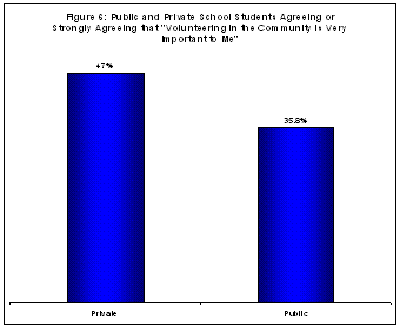
Ah well, tolerance isn’t the only civic virtue- volunteerism counts as well. Next we asked:

Tolerance 5


and while we were at it:


Tolerance 6


There were no meaningful differences between private school students attending with the assistance of a tax credit scholarship, and those who did not receive a scholarship. A minimum of 41% of tax credit scholarships are given out by groups that employ a means-test, so it is not the case that the private school kids are all wealthy and attending Dead Poet Society Schools, which are few and far between here in Arizona in any case.

Of course not all, and perhaps even none of the observed differences can be attributed to the actions of the schools. This however seems very unlikely. This was a survey of high-school students. I know I didn’t have a clue about my family income when I was in high-school, and thus wouldn’t believe the numbers we might get from asking about it, so we didn’t ask.

These results however strongly debunk the notion that private schools function as intolerance boot camps. In fact, it is much easier to build that sort of a case against public schools with the available data, though more research ought to be done.

Arizona’s $2,000 tax credit scholarships are looking like quite the bargain compared to $9,700 Arizona public schools. If you care about tolerance and volunteerism, that is.

More soon on how Arizona high school students view their schools.


Bud Light Makes an Ad about Ladner

September 9, 2009


(Guest Post by Matthew Ladner)


Still More Lefties for School Choice

September 9, 2009

Monopoly - Pennybags

Can you sell school choice to monopolists?

(Guest post by Greg Forster)

We’ve been tracking the increasing movement on the political left toward school choice.

Now, Arianna Huffington repackages school choice for the lefty crowd, connecting it to the health care debate by calling choice “single payer for education,” i.e. you choose the provider and government pays.

The association is distasteful, given that the pending government takeover of healthcare is a knife at the throat of our freedom. But if this is how some people need to think about it in order to see the point about school choice, that’s fine as far as it goes – in education, moving to a “single payer” system would be a step in the right direction, as opposed to a step in the wrong direction as with health care.

HT Eduwonk


New Blog — Mid-Riffs

September 8, 2009

Check out the new blog, Mid-Riffs.  It’s got a catchy name for a blog offering “a view from mid-America.”  In it’s inaugural post it declared:

“While those of us that contribute here won’t always agree, we are bound by a shared appreciation for good arguments, logical consistency, geeky sarcasm, and all things good.  We are against things that are bad (e.g., Texas).”

And in its first substantive post, Mid-Riffs takes on the new high school millage in Fayetteville, Arkansas.

(edited to correct typo)


Mostly Harmless

September 8, 2009

Many electrons have already been spilled on Obama’s speech today to the nation’s school children.  When news first broke of the planned speech, alarms were raised by Michelle Malkin, Glenn Beck, and Neal McCluskey (among many others). 

This was followed by a counter-backlash from the left as well as folks on the right, including the Wall Street Journal and Tunku Varadarajan at Forbes, who said that the initial reaction was “overwrought” and “demented” (respectively if not respectfully).

The counter-backlash is correct that the speech is basically harmless.  Telling kids to stay in school, say no to drugs, and the like is the sort of thing that Nancy Reagan used to say (and people used to mock not because it was indoctrinating but because it was likely ineffective.)

It’s worth stepping back from this kerfuffle to wonder why the president making a speech to the nation’s school children while they are in school is such a big deal.  The counter-backlash wants to suggest that the original backlash against the speech was motivated by crazy, conspiratorial thinking.  Presidents talk to the country all the time, they note.  And if the problem is supposed to be in the lesson plan proposed by the U.S. Department of Education, teachers can use or ignore these suggestions as they wish, just like they can regularly choose lesson plans.

But that is at the heart of the backlash and is not entirely crazy.  Parents sense a lack of control over what their children are taught in school.  This is as true of every day’s social studies lesson as it is of Obama’s speech.  Most of those lessons, just like the president’s speech, are likely to be unobjectionable to most parents. 

But on a fairly regular basis schools teach (or fail to teach) some things that are contrary to the values that parents would like conveyed to their children.  To those of us who see education as an extension of child-rearing, compulsory education privileging government-operated schools is an intrusion of the government on this parental responsibility.  To others, the intervention of the government is a positive good, protecting children from potentially dangerous values of the their parents and assuring allegiance to a common set of ideals necessary for our society to function.  As an empirical matter, government-operated schools are actually less effective at conveying that common set of ideas than are schools selected by parents.  

Amy Gutmann, in the widely read book, Democratic Education, argues that this is not really an empirical question.  The principle is that there should be some democratic input into what is taught to children, not just parental control.   But in a chapter in the book, Learning from School Choice, I dissect Gutmann’s book to show that her scheme isn’t democratic at all.  She believes that local democracies should control schools as long as they avoid discriminating and repressing.  The problem is that almost everything of importance that they do could be portrayed as discriminating or repressing.  So who, under her scheme, resolves these disputes about what is permissible for local democracies to control in schools?  Unelected judges and unelected teaching professionals.  Gutmann’s proposal is really to substitute the dictatorship of an elite for the dictatorship of parents.  As I’ve argued before, I prefer to trust even poorly educated parents to make decisions in the best interests of their own children than well-trained but differently motivated bureaucrats.

So, beneath the over-reactions and counter-over-reactions on Obama’s speech today is a real issue — Who should have primary responsibility for raising (educating) children?