(Guest Post by Matthew Ladner)
Reason TV on DC vouchers. BOOOOOM!
(Guest Post by Matthew Ladner)
Reason TV on DC vouchers. BOOOOOM!
 1 Comment |
  vouchers | Tagged: D.C. vouchers, Reason Foundation, Reason TV |
  Permalink
 Posted by matthewladner
The NYT has threatened to shutter its Boston Globe subsidiary in 60 days if its unions don’t agree to various cuts. According to the Times’ own coverage:
Hmmm…. What would the New York Times say if someone else, like let’s say Walmart, threatened to close down its units because unions would drive costs too high. Oh, wait, they did write an editorial about that on August 16, 2008. It begins:
I guess it is hardly news that the New York Times would engage in the same practices that they find deplorable if allegedly done by others.
And who could forget this gem of an editorial by the Times on December 28, 2008? Just a few months ago the Times seemed to think that expanding union power was great because it would raise wages, which was necessary for economic recovery:
Come on NYT! Can’t you follow your own advice? Do your part for the economy and raise those Boston Globe wages higher rather than slashing them.
(edited for typos)
5 Comments | economics, politics | Tagged: Boston Globe, New York Times, Walmart | Permalink
Posted by Jay P. Greene
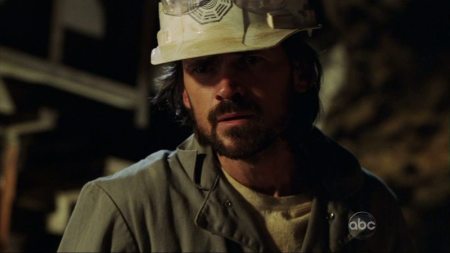
Add “undercover agent” to his list of mad skills
(Guest post by Greg Forster)
Late is better than never – thoughts on last week’s Lost:
1) Waaaaaay back in the day, I used to play “theater sports.” If you’ve seen the show Whose Line Is It Anyway? you’ve got the general idea of what it’s like – actors do it for recreation and practice. Basically you’re given an outline of a scene and you have to start playing it immediately.
The cardinal sin of theater sports is “blocking.” This is what they call it when you violate the narrative cues you’ve previously laid down. It generally happens when two members of the team want the scene to go in different directions. One will say something like, “hey, check out that funny-looking bird up there!” and the other will say, “that’s not a bird, it’s a Chinese bomber – run!”
Blocking is the supreme sin because audiences need narrative structure. Surprise twists are one thing. But they need to take place within the context of a narrative universe that has “rules.” If absoultely anything can happen at any time, there’s no drama. So, for example, if it was previously established that the first character had bad eyesight, the dialogue in the paragraph above would not be blocking, it would be a gag. But you can’t just change the rules of the narrative every time you have a new idea for where you want it to go.
This issue has come up before on our Get Lost feature. So let me just admit that Jay has been vindicated – Lost is blocking big time. First they worked really hard to establish the one supreme rule of time travel – whatever happened, happened. Then they pull the rug out.
Even if it turns out that Dan was right the first time and you really can’t change the past – after all, he now thinks you can, but we haven’t seen him actually do it yet – last week’s episode was still blocking.
“Do you know what destiny is?” More like, do you know what good narrative structure is?
2) He’s a tortured artist, tragic lover, philosopher of time and space, undercover agent and cool-under-fire action hero. Oh, and he’s the son of the major villain! (Whoops – spoiler alert.)
I see the inexorable operation of the Wesley Wyndham-Price Axiom is well underway.
Daniel was shot at the end of the episode, but we know he’s not dead because the Axiom states he has to kill some bad guys and win the affections of at least one more smoking hot chick before he goes.
I had Matt hook me up with a Vegas bookie, who gave me the official odds (for entertainment purposes only) on which female will be the next to “notice” Daniel:
Juliet 1 to 5
Relationship with Sawyer is on the rocks; they’re both eggheads
Kate 1 to 20
Recently revised from 1 to 40 because she’s now stranded in the jungle with him
Claire 1 to 25
Remember Claire?
Naomi 1 to 50
It could happen in a “flash forward” showing Dan’s recruitment
Sun 1 to 100
A long shot, I know, but we’re running out of females here
Eloise 1 to Ewwwwwwwwwwwwwwwwwwwwwwwww.
Hey, Leia kissed Luke. (Bet you wish I hadn’t reminded you.)
3) Looks like Jay was right the first time when he expressed doubt that the past was really unchangeable.
4) I’ve noted twice before that for a guy with unlimited cash and an army of goons who’s made tons of enemies and tampered with terrifying occult powers, Widmore’s security really stinks. I wondered the first time whether there was some unknown reason Widmore couldn’t be killed. Now that time travel has been introduced on the show, perhaps that explains it.
But given that on last week’s episode, Dan just walked right into the Others’ camp with gun drawn and managed to take them all napping – well, it’s looking more like Widmore is just not a super-genius on the security front. I assume the Others got much more badass after Ben took over, which is why they’re all deadly forest ninjas in 2004.
5) How did Richard know Dan wouldn’t shoot him? Advance knowledge of the timeline? Or is he just a good judge of character? (Or perhaps he’s a lousy judge of character and Dan really would have shot him!)
6) Apparently Eloise knows the future – she apparently knew that Theresa is going to get the whammy from Dan’s Frankenstein-of-Time routine, and at the end she says that it’s the first time in a long time that she didn’t know what was going to happen. Does she have advance knowledge of the timeline, or a superpower? And why doesn’t she know the future now? Maybe because the timeline changed?
7) Dan unsuccessfully tried to persuade Dr. Chang that he was from the future. Afterward, he didn’t seem disappointed that he had failed. He tells Miles he was just trying to ensure Dr. Chang would do what he was supposed to do. What’s he supposed to do? Does Dan have a hidden agenda?
8 ) At a critical moment, Jack notices grey drums labeled FUEL. Wow, good thing Dharma labels absolutely everything with big, huge capital letters!
15 Comments | Lost | Tagged: Greg Forster, Lost | Permalink
Posted by Greg Forster

My colleague, Gary Ritter, and NEA boss, Dennis Van Roekel debated merit pay on the PBS NOW web site.
At the bottom you can vote for who you think won the debate. Gary currently has 67% of the vote. Bam!
2 Comments | teacher pay | Tagged: Gary Ritter; Dennis Van Roekel, merit pay | Permalink
Posted by Jay P. Greene
This one is from the ranking minority member of the House Committee on Oversight and Government Reform, Rep. Darrell Issa. Rep. Issa wants to know who at the U.S. Department of Education knew what and when did they know it concerning the D.C. voucher evaluation released weeks after a crucial vote to kill the program.
Here is the press release from Issa’s office in full:
WASHINGTON. D.C.– House Committee on Oversight and Government Reform Ranking Member Darrell Issa (R-CA) sent a letter today to Education Secretary Arne Duncan questioning the timing of a study evaluating the District of Columbia Opportunity Scholarship Program (OSP) which revealed that participants in the program outperformed those not in the program with regard to reading tests and other key measurements.
“Prior to the release of the OSP evaluation, the Omnibus Spending Bill was passed by Congress and signed by the President on March 11, 2009. The bill contained a thinly disguised “poison pill” which had the effect of terminating the OSP, threatening to force those students with these scholarships back into dangerous, academically-underperforming schools, and preventing others from being offered such scholarships in the future,” Issa wrote. “I am puzzled by the timing of the release of the positive OSP evaluation; just three weeks after Congress de facto killed the program on March 11. It is highly possible that Congress might not have terminated the OSP if my colleagues, not to mention the White House, had known that this positive evaluation was about to be issued.”
Issa notes that Oversight Committee Republicans have received credible information that DOE officials were aware of the positive report but kept quiet until after Congress had acted to kill the program. The letter asks Sec. Duncan to provide a response to key questions by May 13thbefore the Senate Committee on Homeland Security and Government Affairs is scheduled to hold a hearing on the OSP.
Specifically, Issa asks the Secretary to provide the following:
Leave a Comment » | vouchers | Permalink
Posted by Jay P. Greene
You are currently browsing the Jay P. Greene's Blog blog archives for May, 2009.

 Jay P. Greene's Blog