Brilliant.
(HT, Stuart Buck and Lydia McGrew at http://www.whatswrongwiththeworld.net/2008/08/great_video_clip_on_government.html#comments )
Brilliant.
(HT, Stuart Buck and Lydia McGrew at http://www.whatswrongwiththeworld.net/2008/08/great_video_clip_on_government.html#comments )
 4 Comments |
  vouchers | Tagged: Jay Greene, Jay P. Greene, Lydia McGrew, school choice, Stuart Buck, vouchers |
  Permalink
 Posted by Jay P. Greene
Well, not really. But I’ve come across two relatively new Arkansas-based blogs (at least they are new to me). One is The Arkansas Project, written by David Kinkade, Freeman Hunt, and Dan Greenberg. Greenberg is a state representative who shares my interest in the naming of public buildings. The other is the eponymous blog, Freeman Hunt. And speaking of the symbolic power of names, Freeman Hunt appears to be her real name.
They join the extremely high quality blog written by Stuart Buck at The Buck Stops Here.
1 Comment | journalism | Tagged: Dan Greenberg, David Kinkade, Freeman Hunt, Jay Greene, Jay P. Greene, Stuart Buck, The Arkansas Project | Permalink
Posted by Jay P. Greene
I recently finished reading Infidel by Ayaan Hirsi Ali and found her story to be very compelling and well-written. She makes a feminist critique of Islamic culture based on her own experiences growing-up in Somalia, Saudi Arabia, Ethiopia, and Kenya. While one could wonder whether the horrible treatment of women that she describes is really inherent in Islam or just in the way Islam is practiced in certain places, she makes a powerful case that anyone interested in progress for women should consider. Certainly anyone who would read Alice Walker, Toni Morrison, or Naomi Wolf, should add Ayaan Hirsi Ali to their reading list.
But then I wondered — given how often these American feminist authors are on high school recommended reading lists, how many of those lists also include Ayaan Hirsi Ali?
I did a quick Google search for the terms “Infidel,” “high school,” “reading list,” and “Ayaan Hirsi Ali.” There were 158 entries after duplicates were removed. Combing through those entries I found four high schools that had Infidel on a recommended reading list.
I did a similar search, substituting “The Color Purple” as the book and “Alice Walker” as the author. That yielded 575 entries (without duplicates). After reviewing the first 158 of those entries I found 49 high school recommended reading lists containing The Color Purple in addition to statewide lists for New York and Florida. There are also many Google entries describing efforts to ban The Color Purple or remove it from recommended reading lists, but it is clear that those efforts have largely failed. The Color Purple is widely suggested for high school students to read by school officials.
Why is Ayaan Hirsi Ali largely absent from high school reading lists while Alice Walker is so common? Perhaps the difference is explained by the literary quality. Walker is read for her literary skill in addition to the themes she addresses, but I somehow doubt that literary quality fully accounts for the difference. And I should emphasize that Infidel is very well-written. Her detached, almost clinical tone, helps the reader grasp the horrors she describes. And Ali writes without anger and with a fair level of sympathy, even for those who treated her very poorly.
Instead, I suspect that at least some of the difference is attributable to the fact that Walker’s feminist critique hits closer to home, while Ali describes issues that are more remote. In part, this is reasonable because we legitimately have a stronger interest in things that are closer to us. But in part this seems unreasonable. If we feature only criticisms of Western treatment of women and neglect accounts of even more horrifying treatment elsewhere, we deprive students of a sense of perspective and proportion. Students might fail to appreciate the accomplishments and progress of Western civilization because of the inability to compare it to the accomplishments and progress made in other civilizations.
Infidel contains many controversial and disturbing issues. But so does The Color Purple. It would be nice if we are willing to address those controversial and disturbing issues even when they don’t occur in our backyard.
7 Comments | civic values | Tagged: Alice Walker, Ayaan Hirsi Ali, high school reading lists, Infidel, Jay P. Greene. Jay Greene, The Color Purple | Permalink
Posted by Jay P. Greene


In keeping with our love of summer blockbuster sequels, I have another post on school mascot names. Just to set the stage, let’s have a flashback to my first mascot post:
“The names we choose matter. When we name our children, or name a public school, or name a public park or courthouse — we are signaling what is important to us. Once names are given, there is an opportunity for people to learn about the values those names represent and promote those values in the world.
With Brian Kisida and Jonathan Butcher, I have already analyzed patterns and trends in what we name public schools. We found a trend away from naming schools after people, in general, and presidents, in particular. Instead, schools are increasingly receiving names that sound more like herbal teas or day spas — Whispering Winds, Hawks Bluff, Desert Mesa, etc…
[We found] that there are more public schools in Florida named after manatees than George Washington.
Now I am turning my attention to school mascots. I understand that mascot names aren’t taken very seriously and are often chosen without much deliberation or care. But even something trivial, like what we name our pets or the mascot names we adopt says something about us. Besides, this is a bit of fun.”
In a subsequent post I identified a national data set of mascot names and offered some very preliminary analyses. With the help of Jonathan Butcher and Catherine Shock, I now have some more detailed analyses to present. In particular, I can show a list of the most common mascot names, show that Indian or war-like mascot names are fairly common, and show that those Indian or war-like names have not become dramatically less common over time.
I have a list of 19,785 mascot names (including some private and Canadian schools), while there are about 23,800 public secondary schools in the US (some of which probably do not have mascot names). So, my list captures a large portion of all high school mascot names in the US.
There are 1,566 unique mascot names, but the more common 182 names account for 88% of the total. Below is a list of the 60 most common mascot names, which account for 79% of all mascot names. As you can see, animal mascots predominate. Human or humanoid (like devils) mascots are about 36% of all names. The remaining 64% are almost all animals, with a sprinkling of weather names (e.g., blizzards, hurricanes, tornadoes).
Eagle, which suggests both patriotism and ferocity, is by far the most common mascot name, accounting for 6% of all names. The next most common names are tigers, bulldogs, panthers, and wildcats. The most common “person” mascot is warrior, which ranks 6th and accounts for 3% of all mascot names.
Rank Name Frequency
| 1 | eagle | 1223 |
| 2 | tiger | 914 |
| 3 | bulldog | 816 |
| 4 | panther | 804 |
| 5 | wildcat (or kit) | 706 |
| 6 | warrior | 630 |
| 7 | lion | 507 |
| 8 | cougar | 469 |
| 9 | knight | 466 |
| 10 | indian | 435 |
| 11 | hawk | 424 |
| 12 | mustang | 400 |
| 13 | raider | 399 |
| 14 | bear | 387 |
| 15 | trojan | 387 |
| 16 | viking | 362 |
| 17 | falcon | 361 |
| 18 | devil | 336 |
| 19 | wolves | 325 |
| 20 | ram | 322 |
| 21 | cardinal | 299 |
| 22 | spartan | 288 |
| 23 | pirate | 268 |
| 24 | hornet | 264 |
| 25 | patriot | 241 |
| 26 | crusader | 210 |
| 27 | rebel | 188 |
| 28 | bobcat | 182 |
| 29 | yellowjacket | 164 |
| 30 | angels | 155 |
| 31 | wolverine | 146 |
| 32 | dragon | 143 |
| 33 | huskie | 143 |
| 34 | titans | 140 |
| 35 | saint | 137 |
| 36 | jaguar | 134 |
| 37 | charger | 126 |
| 38 | braves | 116 |
| 39 | rocket | 111 |
| 40 | chief | 107 |
| 41 | pioneer | 102 |
| 42 | cavalier | 88 |
| 43 | bronco | 77 |
| 44 | ranger | 75 |
| 45 | redskin | 72 |
| 46 | cowboy | 71 |
| 47 | owl | 71 |
| 48 | gators | 70 |
| 49 | longhorn | 69 |
| 50 | hound | 66 |
| 51 | tornado | 66 |
| 52 | royal | 66 |
| 53 | bruin | 63 |
| 54 | bluejays | 61 |
| 55 | hurricane | 55 |
| 56 | buccaneer | 55 |
| 57 | highlander | 55 |
| 58 | colt | 55 |
| 59 | irish | 54 |
| 60 | buffalo | 53 |
Indian mascots, including chiefs, braves, and specific tribal names, are about 4% of all mascot names. The warrior is sometimes represented by a Native American, but I have not included warriors among Indian mascots.
Indians are not the only ethnic/national group featured as mascots. There are also a fair number of Highlanders, Irish, and Scots as mascot names.
War-like names, including anything with “fighting” in it or warriors, raiders, pirates, bombers, etc…, are about 19% of all mascot names. Excluding animal mascots, war-like mascots account for about half of the remaining “people” mascots. Respect for a martial spirit is represented in a very large portion of all mascot names.
This interest in ferocity has only declined slightly over time. Repeating a technique that I employed in the study of school names, I used the age of school buildings as a sort of “time machine.” If schools built more recently have mascot names that are different from schools built a long time ago, then we could observe a trend in mascot selection over time. Of course, there are problems with this technique. For example, old schools might change their mascot names. I can’t observe old schools that have closed. I only have building age for a limited number of schools in a limited number of states.
With all of these confessions out of the way, I still believe that if there were a big change in mascot names, newly built schools should have very different mascot names than old schools. I do not find a big change.
I looked at mascot names for schools built before and after 1970 in Arizona, Florida, Massachusetts, Ohio, and Wisconsin. There appear to be some modest trends. Schools seem to be less likely to have a “person” mascot over time. Animals are becoming somewhat more common as mascots. And Indian mascots in these five states are becoming less common, but by no means have disappeared. Lastly, there has been a modest decline over time in schools having war-like names.
| Before 1970 | After 1970 | |
| “Person” | 40.0% | 35.6% |
| Indian | 8.1% | 6.5% |
| War-Like | 22.2% | 19.2% |
It’s possible that flaws in the analysis are understating the trends, but even if that were the case the changes are unlikely to be large. The shift away from “people” mascots, away from Native American names, and away from war-like names is happening, but it is happening gradually.
My guess is that the appeal of tradition in mascots is likely to be very strong. Change can only occur gradually, as old schools are closed and new ones opened. We occasionally hear news stories about schools changing mascots, but those stories may account for almost all of the instances of such shifts actually occurring. When a school changes mascots it tends to make news.
Curiously, the change in mascot names over time is much less dramatic than the change in school names. Perhaps school boards increasingly avoid naming schools after people because they wish to avoid fights over who should be honored, but are less politically sensitive about mascot names because they provoke less conflict. Maybe our commitment to the values of fierce mascots has not changed much over time, while our commitment to honoring great presidents, educators, and other people has declined.
The first person to post a comment identifying the schools and mascot names represented by the three images at the top wins a prize!
15 Comments | civic values | Tagged: Jay Greene, Jay P. Greene, mascots, school names | Permalink
Posted by Jay P. Greene

(Guest post by Greg Forster)
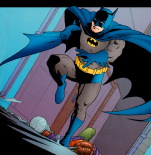
Okay, and now for something completely different! Today we’re going to talk about Bat Gear.
What was the one thing in The Dark Knight that just didn’t work? So far, everyone I’ve talked to has the same answer, even if you don’t ask them the question – it’s the citywide “sonar.” Lame.
The first time through, it was really obtrusive – for a few minutes. One of the greatest innovations in storytelling in the last ten years is that movie and TV people have learned the value of throwing a lot of story at you and trusting you to keep up; among many other virtues, this means badly done moments in the narrative get left behind more quickly.
The second time through, I didn’t really mind. That was partly because dumb plot elements are always less obtrusive the second time around, because you aren’t being hit with the shock of recognizing their stupidity. This, for example, is why it is possible to watch the Lord of the Rings movies repeatedly without their being spoiled by a bunch of friggin’ elves marching into Helm’s Deep, or the army of the dead effortlessly wiping out the beseiging force at Minas Tirith (which means all those Rohirrim who gave their lives on the Pelannor died for nothing).
But it was also partly because the second time I saw how it was supposed to fit into the movie. Somehow, the first time through, I totally missed the “like a submarine” gag. You remember, when Lucius comes out of the evil corporation’s building in Hong Kong and shows Bruce the sonar readout:

“Sonar? Just like a . . .”
“Like a submarine, Mr. Wayne – just like a submarine.”
It just flew by and I missed it completely. (How am I supposed to catch all these little things when they throw so much at you and expect you to keep up with it all?)
Obviously they were thinking that we would buy the “sonar” because sonar fits with the bat theme. And it’s not a crazy theory. When a plot element fits the theme of the movie, artistic liberties with reality are much less obtrusive (a subject I’ve had occasion to discuss at greater length before).
But it didn’t work. And that got me thinking about the gadgets in this movie. F’rinstance, does the Bat Cycle (apparently to make it seem less fruity they’re telling us to call it a Bat Pod) belong in this movie? I mean, honestly – doesn’t it just look like the suits in the marketing department demanded that they throw in something new that would sell toys? After all, the twelve year old boys of America – who should never be permitted to see this movie under any circumstances whatsoever – are not going to shell out for another Batmobile unless it’s different from the last one.

He’s prob’ly fighting for freedom! Buy all our playsets and toys!
And the skyscraper-assault gadgets (in the Hong Kong scene and again in the assault on Fortress Joker) feel artificial, too.
But that’s not what you’d expect, is it? Gadgets belong in a Batman movie. They’re an integral part of the franchise – even more so than in the James Bond franchise.
Consider the first Batman movie – well, okay, not absolutely the first, but the first one that counts. The Tim Burton one. (The Tim Burton one that counts.) That movie doesn’t get its propers anymore, in large part because we now take for granted so much of what Burton did to define the modern comic book movie. Much of what was radical in Burton’s Batman is now so expected that it’s not even noticed.
It was a much more uneven movie than Nolan’s Batmans are – parts just didn’t work, but parts worked brilliantly. And that movie was just brimming with gadgets. The Batmobile actually did stuff – and no, going really fast and changing the driver position from Standard Seated Position to Lying Down for No Reason Position doesn’t count as doing something. Yes, okay, in the first Nolan movie the Batmobile jumped rooftops. But Burton’s Batmobile did so much more. And Batman himself used gadgets more often and it felt more natural. One of those brilliant moments that really worked was when Batman swooped in, foiled one of the Joker’s plans, and swooped out on one of his flying wires (or something) and the Joker was just so impressed that he didn’t even think about how badly he’d been beaten – he just stood there and asked: “Where does he get those marvellous toys?”
Or consider what must be the best gag ever done in a comic – from the Batman/Planetary crossover.

(If you don’t know what Planetary is . . . well, how are you even alive?)
Anyway, the Planetary crew are in Gotham chasing a man whose mind keeps opening dimensional rifts, and of course they run into Batman, who of course is chasing the same guy. But every time the guy opens a dimensional rift, they shift to an alternate reality where Batman is slightly different:





HT Planetary. How many can you identify? How many will you admit you can identify? (No fair peeking at the URLs!)
Here’s the gadget gag: Jakita Wagner, a superpowered female hero, is about to throw down with one of the badass Batmans. Then a rift opens and suddenly it’s not a badass Batman, it’s the Adam West Batman from the supercamp sixties TV show. And . . . he would never hit a girl!
So when she rushes him, he avoids compromising his honor by whipping a spray can out of his utility belt and dousing her in the face. (I always suspected the Adam West Batman was really a sucker-punching bastard.) She falls back, clutching her eyes, and Batman drops the can and springs away to chase after the rift-opening guy. As she curses him, we see the can roll into the frame.
The label on the can reads: Bat Female Villain Repellent.
I swear I Googled for probably half an hour looking for that panel, so I could share it with you. I guess you’ll have to buy the crossover instead.
But back to our subject. Gadgets not only belong in Batman, they ought to belong in Chris Nolan’s Batman. After all, this is the first movie version to include Batman’s “Q”, and he’s used to outstanding effect in both movies. What are the most memorable moments in the first movie? Liam Neeson blathering on about destroying Gotham? Dr. Crane attacking people with his fear drug? No, that movie had some of the least interesting villains ever to appear in a comic book movie. (Not a criticism – that movie was about Batman, not about them.) What you remember is: “Oh, the tumbler? You wouldn’t be interested in that.” And: “Just don’t think of me as an idiot.”

And Chris Nolan clearly knows how to get the best out of Morgan Freeman, because he’s used just as well in the new one. That “your plan is to blackmail this person?” speech is priceless.
Come to think of it, in the first movie Batman used a “bat caller” gadget to produce a swarm of bats where he needed it. It was ridiculous, of course – but it fit the theme of the movie, especially in that it was trying to explain why Bruce Wayne chose to dress up like a bat when fighting crime. Being attacked by a swarm of bats would tend to put the fear in you.
So why didn’t the gadets work in this one? The first thought to occur to me was that they were trying to force the citywide sonar to perform an awkward plot function – they wanted to abruptly set up a little mini-debate between Batman and Lucius on the whether it’s OK to spy on the whole city. But frankly, I don’t really think that’s it. I think citywide sonar would have failed even without that scene. (Speaking of which, when I first saw it, I thought that Lucius’s position was “This is wrong, but I’ll do it just this once,” which of course is a contemptable position. But that’s not what he says, as I discovered upon seeing the scene a second time. I think his position is really “This is OK as a one-time deal, but it would be wrong to use it on an ongoing basis.” I’m inclined to think that if it’s OK as a one-time deal, it’s hard to justify throwing it away, especially in a city that seems to attract supervillains like a magnet – but it’s not a contemptable position.)
Maybe – and I’m not sure about this – maybe it’s just that they obviously could have accomplished the same thing with less tampering with reality. Batman could have simply set up a computer to scan all phones for the Joker’s voice. And they could still have worked in the bat/sonar theme by equipping the Batsuit with its own sonar, which he could then have used in the Assault on Fortress Joker scene.
Like I said, I’m not sure. Theories?
(Oh, and I’m still hoping somebody can help me with the tally on Dent’s body count. I’m one cop short.)
2 Comments | Pass the Popcorn | Tagged: Batman, Best of Greg, City of the Dark Knight, Greg Forster, Pass the Popcorn, The Dark Knight | Permalink
Posted by Greg Forster
(Guest post by Greg Forster)
I have a column up on Pajamas Media noting that education just flared up in the presidential race recently, and then asking (and answering) the question: Just what can a president do about education, anyway, given that it’s primarily an area of state authority rather than federal?
It’s a question worth asking, because education is going to come up again before this campaign is over. Well, here are five things the next education president (they’re all “education presidents” these days) can do to improve the nation’s schools without expanding federal authority over education beyond its current level.
Leave a Comment » | NCLB, politics, teacher pay, teacher quality, vouchers | Tagged: Greg Forster, Pajamas Media | Permalink
Posted by Greg Forster
You are currently browsing the Jay P. Greene's Blog blog archives for August, 2008.

 Jay P. Greene's Blog