
(Guest Post by Ben Ladner)
Editors note: Ben Ladner is a Senior at the Arizona School for the Arts in Phoenix.
Tell me if you’ve heard this one before: a nerdy, socially confused teenager looking for a place he can fit in discovers community in a game and the fellow people who are obsessed with it. I suspect you all know the story – more than one of the regulars here grew up on Dungeons and Dragons. But while I’ve raided a few bandit hideouts in my time, my story is about a different but no less revolutionary game: Magic: the Gathering.
In the early 1990s, Richard Garfield was an unkempt mathematics post-grad who designed games in his spare time. He and a friend pitched a board game to Peter Adkison, CEO of Wizards of the Coast, a small gaming company looking for an innovation to sell, but it was too complex for Adkison’s scrappy firm to handle. Adkison wanted something smaller and simpler, that could be played quickly between rounds at larger conventions. Garfield told Adkison that he might have something, what he returned with was nothing short of a revolution.
Magic: the Gathering, released in 1993, is a combination of baseball cards and chess. Cards representing various high-fantasy monsters, arcane spells, and powerful magic items can be collected and traded, but each has play value in a strategic, intellect-based game that pits players and their decks of cards against each other. Players use their collections to fine-tune their decks in a game world that is ever-changing as regular expansions add new cards to the mix.
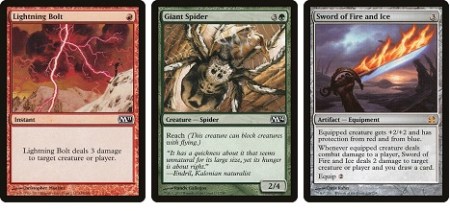
Magic was the first game to combine the two previously unrelated concepts, and it has become no less of a paradigm shift in the gaming world than D&D was a generation earlier. Trading card games are everywhere now, and Magic is still going strong with over 20 million fans. Its rise coincided with that of the internet, leading to a strong presence there among the players. Some have become celebrities of sorts, leading the way in the world of e-sports as they compete in professional-level, livestreamed tournaments. I, for one, care much more about the Magic: the Gathering Pro Tour than I do about any mainstream sport.
I am a nerd. I lead a robotics club at my school, unabashedly cosplay for no reason, and have a map of the Klingon Empire pinned up in my bedroom. For most teens, this would be a social death sentence, but Magic saved me. I play in local tournaments whenever I can, and the community of people I have met at these events is no less nerdy or obsessed that I am. I feel comfortable being me when I’m there. Among the older players are people I would look up to as mentors and examples. I, and millions of others, owe Magic an unpayable debt. It has given us an outlet for our creative energy, a community, and a common bond.
As for Garfield, he pocketed 100 million dollars when the wildly successful Wizards of the Coast was bought by toy giant Hasbro, and moved on with his life. While he continues to design games, he understands and accepts that he will forever exist in the shadow of his creation. In his words; “Pretty early on, I realized that trying to make the next Magic only going to make me unhappy.” Garfield’s later projects, which have seen some success, are made with the same obsessive passion that brought forth Magic, not in some futile attempt to measure up. That’s not to say Garfield is above continuing to tinker with Magic. He returns to the game from time to time, and the expansions he helps create, such as 2005’s Ravnica: City of Guilds, the gothic-horror themed Innistrad, released in 2011, and most recently Dominaria this year, are among the most innovative and best-loved by players.
Richard Garfield created something that has made life better for millions of nerds like me. And he did it because he is just as much a nerd as we are. He wasn’t in it for money or recognition, though he has received much of both. He just wanted to make something cool. For that, he is worthy of the title “humanitarian of the year.”


 Posted by matthewladner




 (Guest Post by Matthew Ladner) Amazon Prime just informed me that
  Just in case no one else is going to suggest it, a Weird Al/Me First and the Gimme Gimmes team up would be totally awesome unless it was so awesome that it tore a rift in space-time, unleash cosmic parody forces beyond human comprehension or control, in which case it would be really TOTALLY AWESOME.


 Jay P. Greene's Blog